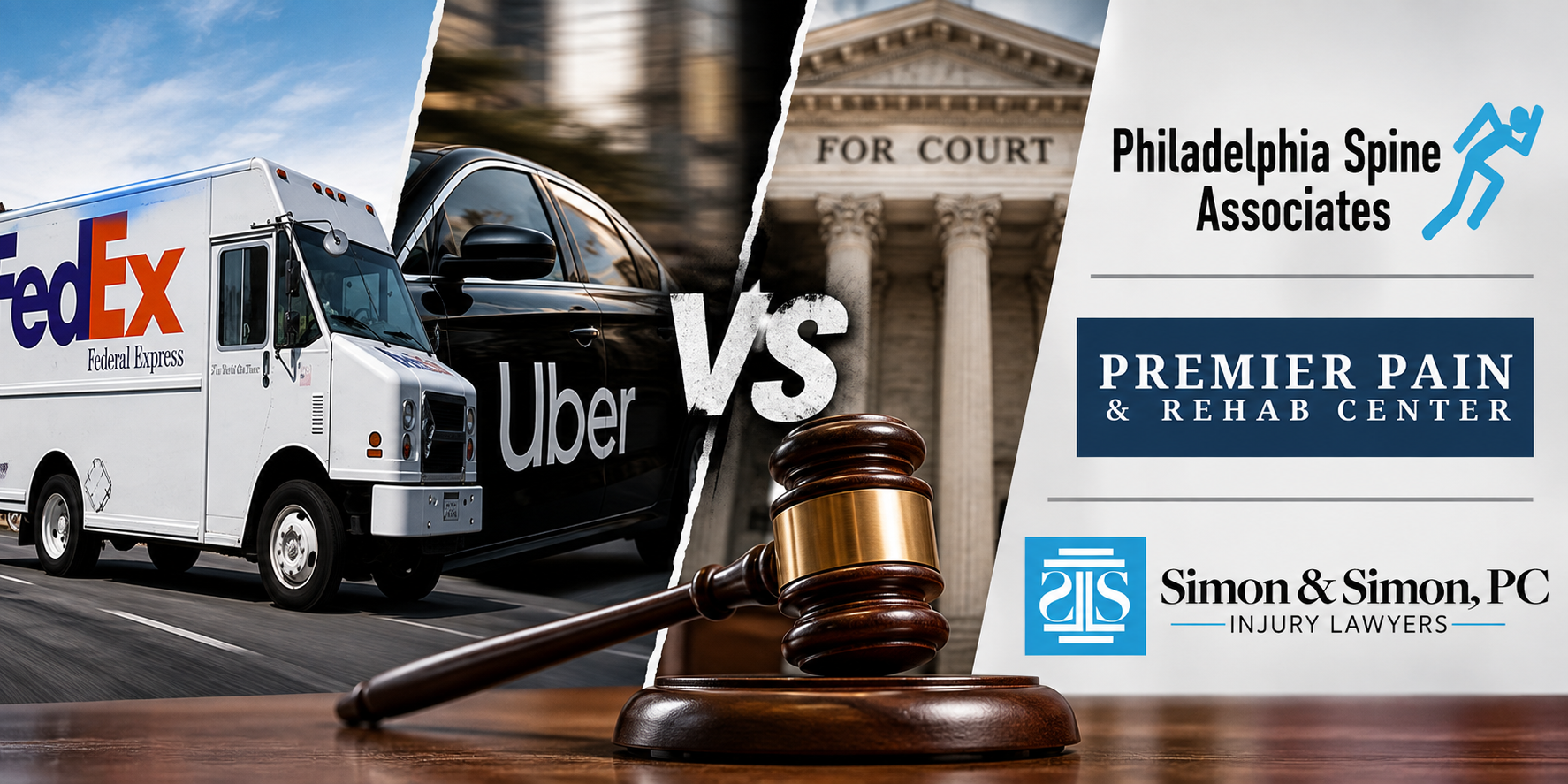
Uber and FedEx filed a civil RICO complaint against a Philadelphia personal injury firm and its network of doctors. A federal judge let it stand. The trucking and freight industry should be paying close attention.
On September 18, 2025, Uber Technologies filed a 66-page complaint in the U.S. District Court for the Eastern District of Pennsylvania, docket 2:25-cv-05365, assigned to Judge Mark A. Kearney. The defendants were Simon & Simon P.C., its founder Marc Simon, pain specialist Dr. Clifton Burt of Premier Pain & Rehab Center, chiropractors Ethel Harvey and Daniel Piccillo of Philadelphia Spine Associates LLC, and medical-legal expert Dr. Lance Yarus. FedEx Corporation joined as a co-plaintiff. The cause of action was 18 U.S.C. §§ 1961 et seq., the Racketeer Influenced and Corrupt Organizations Act. That is not a statute you reach for when you’re tired of losing fender-bender cases. That’s a statute you reach for when you believe the other side is running a criminal enterprise.
Marc Simon and Simon & Simon have a straightforward answer. According to court filings, Simon called Uber’s complaint a “baseless” attempt to deter lawsuits against the company and its drivers. His December 2025 motion to dismiss told Judge Kearney that the suit was a “business tactic,” that if you’re a lawyer who dares to sue Uber, the company will call you a fraud, threaten your law license, and demand eight figures in damages. That story is worth stating plainly before the record answers it, because the access-to-courts argument is real and it matters. Not every personal injury firm that sues a deep-pocketed defendant is running a racket. Most aren’t. But that argument has to survive the specific facts in this complaint, and on May 11, 2026, Judge Kearney found it didn’t, at least not yet.
On May 11, 2026, the court denied the motions to dismiss in their entirety in a 54-page opinion, Uber Technologies v. Simon & Simon, P.C., 2026 WL 1284178 (E.D. Pa. May 11, 2026). Every defense raised failed: Noerr-Pennington immunity, res judicata, the Rooker-Feldman doctrine, and challenges to the sufficiency of the RICO pleading itself. The case is now in discovery. All allegations in the complaint remain just that: allegations. Marc Simon, Clifton Burt, Ethel Harvey, Daniel Piccillo, Lance Yarus, and Philadelphia Spine Associates LLC are charged but not convicted of anything, and they’re entitled to the presumption of innocence that attaches to every civil defendant facing fraud allegations of this magnitude.
The alleged scheme, as Uber pleads it, works like this. Simon & Simon identifies clients involved in vehicle accidents, many of them with minor injuries or limited-tort coverage that would cap their recovery at out-of-pocket expenses. The firm then, according to the complaint, directs those clients to go to an emergency room days or weeks after the accident, even when no immediate treatment was needed, to create a medical record showing they sought treatment. From there, Uber alleges, the clients move onto what the complaint calls “a conveyor belt of preselected treatment providers and medical experts.” Dr. Clifton Burt at Premier Pain & Rehab Center sees clients in bulk sessions and prescribes treatments Uber characterizes as unrelated to any underlying injury. Chiropractors Harvey and Piccillo at Philadelphia Spine Associates generate voluminous treatment records and order MRIs, and according to court filings, some of those MRIs came back negative or showed only mild degenerative changes with no connection to the accident. The treatment continued anyway. At the end of the line, Dr. Lance Yarus produces what Uber calls a cookie-cutter life-care plan projecting that each claimant will require a lifetime of expensive medical care, sometimes including future surgery that was never communicated to the patient. The plan goes into the lawsuit. The lawsuit goes to Philadelphia state court. The demand exceeds $50,000.
That $50,000 threshold is the alleged mechanism. In Pennsylvania, a claim over $50,000 stays in court and goes to a jury. Under $50,000, it goes to arbitration. Arbitration produces smaller, faster resolutions. A jury in Philadelphia produces something else entirely. By crossing that line on paper, regardless of what the actual injury was, the firm’s clients become eligible for the kind of verdicts and settlements that make a defense-side risk manager reach for the checkbook. Uber and FedEx say that’s the point. The complaint further alleges that roughly 30 of those suits were voluntarily dismissed immediately after Uber subpoenaed the pain-management provider, an inference Judge Kearney said supported the conclusion that the filings were leverage, not merit-driven litigation.
Philadelphia lawyers know this dynamic. A federal judge in a prior case, quoted directly in Uber’s complaint, wrote that he had yet to see a single case involving the Simon office in which any plaintiff actually pursued the recommended medical care, and that he therefore viewed those reports as litigation documents with little relationship to real-world medical care. That judicial observation is now Exhibit A in a federal racketeering case. Judge Kearney’s May 2026 opinion found that Uber and FedEx had sufficiently pleaded an association-in-fact enterprise under 18 U.S.C. § 1962(c), with common purpose, defined relationships, and longevity, and that mail fraud and wire fraud formed the predicate acts. On the question of proximate cause, the court accepted Uber’s theory that it paid defense costs and inflated settlements it wouldn’t otherwise have paid, rejecting any first-party reliance requirement under Bridge v. Phoenix Bond & Indemnity, 553 U.S. 639 (2008).
The Noerr-Pennington question is the one the defense leaned hardest on, and it deserves a real explanation because it’ll be back. The First Amendment protects the right to petition the government, including the right to file a lawsuit. The Noerr-Pennington doctrine, developed initially in antitrust law and extended to civil RICO, says you generally can’t be held liable for the act of filing a complaint. The defense argued that Uber and FedEx were trying to punish Simon & Simon for doing exactly what lawyers are supposed to do: sue on behalf of injured clients. Judge Kearney rejected that framing. The court looked at the alleged scheme as a whole. Uber and FedEx didn’t sue over any single complaint. They alleged a coordinated racketeering scheme in which lawsuits were the end-stage delivery mechanism for fraudulent medical records manufactured upstream. Pre-filing activity, the referrals, the bulk medical sessions, the templated life-care plans, sit outside the litigation process. Noerr-Pennington doesn’t reach it. Filing the lawsuit was just how the records got cashed in.
Simon & Simon has counterclaimed, arguing that the RICO complaint is itself sham litigation and an abuse of process. Uber and FedEx moved to dismiss those counterclaims, arguing the firm hadn’t supported them, and as of July 2026, that fight remained unresolved before Judge Kearney. The record doesn’t establish that the RICO complaint is retaliatory; it also doesn’t establish that the underlying personal injury cases were fraudulent. Those questions go to discovery, and then to trial if discovery supports them.
This is the fourth civil RICO complaint Uber has filed in the past year. New York. Miami. Los Angeles. Now Philadelphia. Each case targets the same alleged structure: a law firm directs clients to preselected medical providers, the providers generate records on lien arrangements, and the records support demands well above what the injury would otherwise produce. In Los Angeles, Uber noted that approximately 45% of every fare goes to mandated insurance costs. In New York, the state-mandated policy limit for rideshare companies is $1.25 million. Those policy limits are public information, and Uber’s theory is that they make rideshare companies an especially attractive target for inflated claims. That may be right. It may also be that large mandatory policies correlate with serious accidents, and that defense-side frustration with settlement costs isn’t the same thing as fraud. Both things can be true in different cases. The RICO statute doesn’t care which one is true on average. It cares whether there’s a pattern, an enterprise, and predicate acts, and the E.D. Pa. just found those allegations plausible enough to survive a motion to dismiss.
For carriers, brokers, and fleet operators reading this, the freight angle belongs in your file. FedEx is a co-plaintiff in 2:25-cv-05365. That’s not a coincidence of geography. FedEx and its drivers face the same volume of personal injury litigation that Uber does, in the same Philadelphia courts, from the same pool of plaintiff firms. The Pennsylvania Motor Truck Association has said publicly that lawsuit abuse and unchecked litigation costs are among the most serious threats the trucking industry faces, diverting resources from safety investments and threatening small carriers. A trucking company watching this case doesn’t need to be Uber to have skin in the game. If the RICO theory survives discovery and reaches a jury, the template becomes available to any carrier that can document a pattern: the same firm, the same doctors, the same escalation in claimed damages, the same voluntary dismissals after discovery requests. Civil RICO under 18 U.S.C. § 1964(c) lets a prevailing plaintiff recover threefold the actual damages, plus attorney’s fees. That arithmetic changes the conversation about whether it’s worth litigating instead of settling.
The record in 2:25-cv-05365 doesn’t establish that Simon & Simon committed fraud. It establishes that a federal judge found the allegations detailed enough to proceed. The next stage is discovery into the extent to which the doctors’ reports actually drove the lawyers’ decisions to file and to seek damages over $50,000, and that’s where the case either builds or falls apart.
