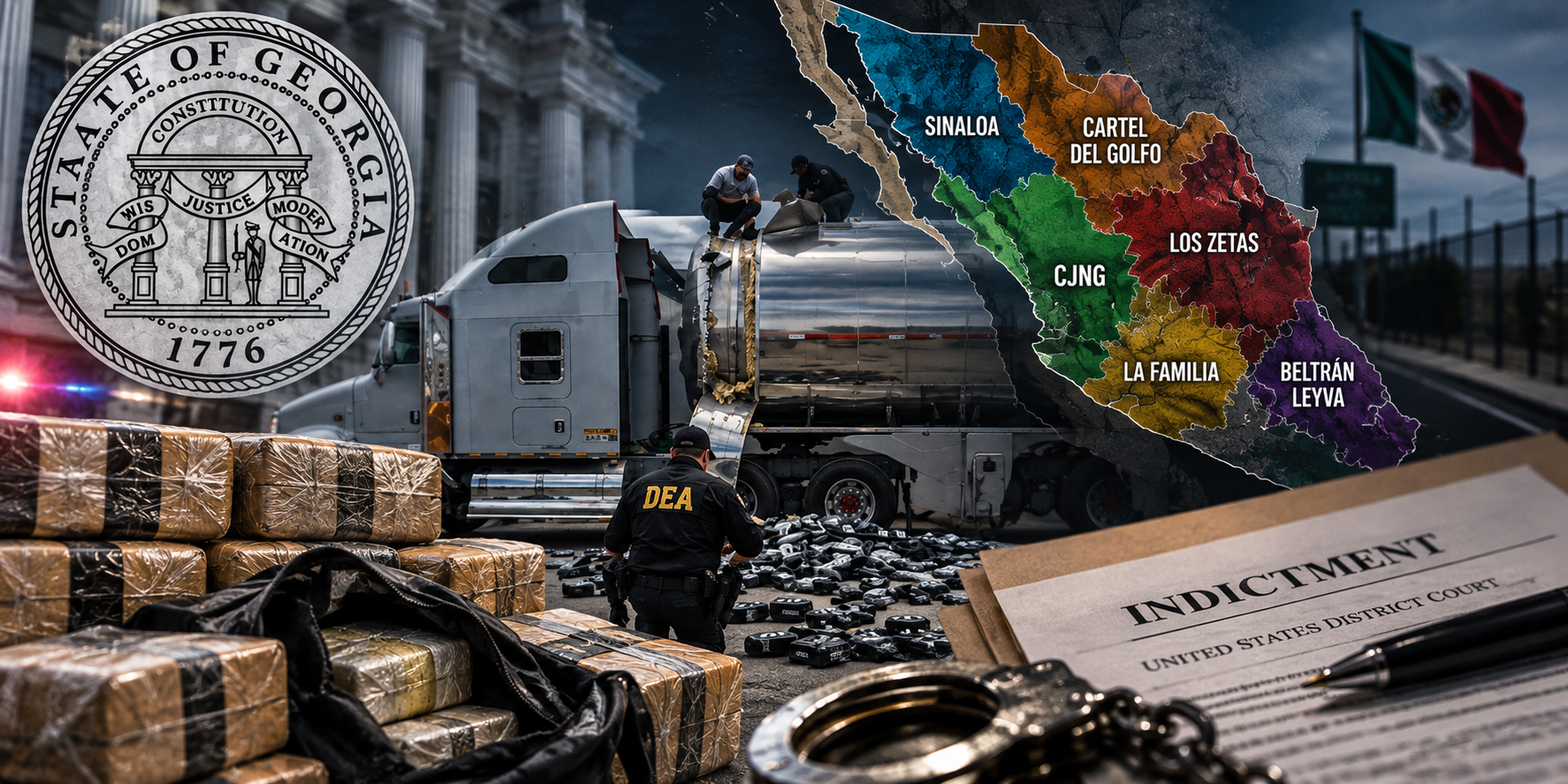
Roberto Lopez, logistics lieutenant for the Sinaloa and Beltran-Leyva cartels, was sentenced to nearly 19 years in federal prison. His bosses got 49 years and 34 years. The trucks, the stash houses, and the cash runs were real. The industry still hasn’t answered who vetted them.
On September 9, 2026, a federal judge in Atlanta sentenced Roberto Lopez to 18 years and 10 months in federal prison, according to the U.S. Attorney’s Office for the Northern District of Georgia. Lopez pleaded guilty on May 19, 2026, to conspiracy to possess with intent to distribute cocaine and conspiracy to commit money laundering. Five years of supervised release follows the prison term. That’s the headline. The headline is not the story.
The story is what Lopez actually did, and how he did it, and how long the industry’s freight infrastructure made it possible. Carlos Montemayor built a trucking and logistics company in Laredo, Texas, starting in 1992, according to the DOJ’s 2019 sentencing release. He specialized in moving goods across the border from Nuevo Laredo into the United States. It was a legitimate business. In 2002, he partnered with Edgar Valdez-Villareal, the Sinaloa and Beltran-Leyva enforcer known as La Barbie, and the trucks stopped carrying legitimate freight. Montemayor’s network began moving up to 300 kilograms of cocaine per week to stash houses in Atlanta, Memphis, and other U.S. cities, then used the same trucks to smuggle drug proceeds back to Mexico in shipments carrying no less than $1 million in cash per load, according to the DOJ press release for Lopez’s sentencing. In a single six-month window in 2005, the organization distributed 1,500 kilograms of cocaine in Atlanta alone, per the DOJ’s account of the Valdez sentencing.
Roberto Lopez made that operation possible. U.S. Attorney Theodore S. Hertzberg described Lopez as “the head of domestic transportation” for those cartels, according to the DOJ’s September 9 announcement. His job was logistics: paying truck drivers, paying stash house operators, repackaging cash before cross-border transfers, and keeping the loads moving. Court-authorized wiretaps captured him discussing incoming cocaine shipments and outbound cash runs destined for cartel leaders in Mexico, the DOJ states. He wasn’t a kingpin in the headline sense. He made sure the trucks showed up, the drivers got paid, and the money got home. That function, the operational logistics layer between the cartel bosses and the freight lanes, is what the industry needs to understand about this case.
Lopez also served as the network’s armorer. According to the DOJ, he personally converted semi-automatic rifles into fully automatic machine guns and manufactured silencers for cartel enforcers. The operation is estimated to have smuggled more than 1,000 rifles, 100 to 200 converted machine guns, hundreds of magazines and ammunition drums, silencers, night vision goggles, ballistic vests, and helmets into Mexico from the United States, according to the DOJ’s sentencing statement for Lopez. The northbound lanes carried cocaine. The southbound lanes carried cash and weapons. The trucks served as the mechanism in both directions.
According to the DOJ, the indictment against Lopez dates to December 15, 2009. When federal investigators disrupted the network that year, Lopez fled to Mexico and stayed there. His co-defendants didn’t have that option or didn’t take it. In 2018, a federal judge in Atlanta sentenced Valdez to 49 years and one month in prison, followed by 10 years of supervised release, and ordered him to forfeit $192 million, according to the DOJ and DEA records. In 2019, Montemayor, the trucking businessman who built the original legitimate logistics infrastructure and then converted it, was sentenced to 34 years and three months, also with 10 years of supervised release, by U.S. District Judge Leigh Martin May. Lopez was still in Mexico City when the judge handed down both sentences. Mexican authorities arrested him there on June 27, 2024, according to the DOJ. Mexico expelled him to the United States on August 12, 2025. He was arraigned, detained, pleaded guilty, and sentenced in about a year. He’s 46 years old.
The DOJ’s announcement names no individual drivers. It identifies no specific border crossings. That’s not a criticism of the prosecution; it’s how a plea to conspiracy charges works. The operational specifics that didn’t have to be proven at trial weren’t always enumerated in the public record. But the structure the record does describe is one that freight professionals recognize: a U.S.-based logistics operator with established cross-border lanes, a driver network, and distribution hubs in major inland cities. Montemayor built that from scratch in Laredo starting in 1992. By the time La Barbie came to him in 2002, the infrastructure was ready. The cartels didn’t build a trucking network from nothing. They rented space inside one that already worked.
The Montemayor model wasn’t a rogue operator running loads out of a gravel lot. In the U.S. attorney’s own words, it was a successful company built on hard work and logistics skill, then converted through a partnership decision. The conversion didn’t change the trucks, lanes, drivers, or dispatch function. It changed the commodity and the customer. From the outside, the carrier profile looks the same before and after. That’s the due diligence problem the case illustrates, and it’s harder than it looks. A USDOT number, active authority, and filed insurance tell you the carrier exists. They don’t tell you what’s on the truck.
Lopez’s case closes the executive tier of the Montemayor network. Valdez got 49 years. Montemayor got 34. Lopez got nearly 19. The DEA Atlanta Field Division led the investigation, with assistance from the U.S. Marshals Service and DOJ’s Office of International Affairs. AUSAs Garrett L. Bradford and Elizabeth M. Hathaway, along with former U.S. Attorney John Horn, prosecuted the case in the Northern District of Georgia. The record doesn’t establish that every driver in the network knew what they were hauling, and this piece doesn’t claim otherwise. It establishes that a legitimate logistics infrastructure was used to move cocaine and weapons at scale for years, that the logistics function was managed by a person now heading to federal prison for nearly two decades, and that the only public signal of any of it was a wiretap that took investigators years to build. If your vetting process wouldn’t have caught Montemayor’s carrier in 2003, it’s worth asking what it would catch today.
