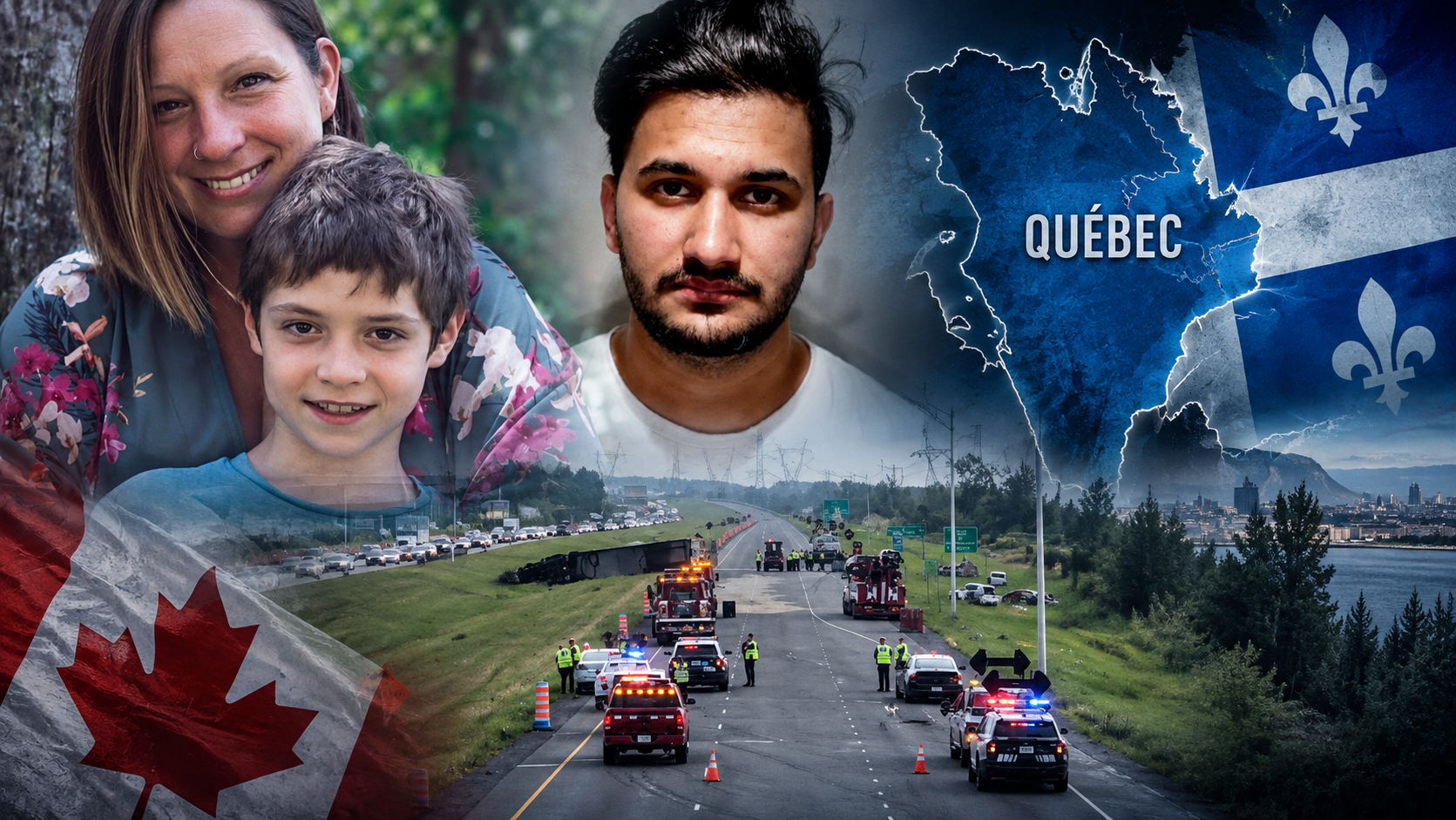
Baljeet Singh drove a 53-foot semi into a construction zone on Highway 30 while running up his eighteenth in-cab phone session of the night. A mother and her son didn’t make it home. The sentence recommended Thursday tells you something real about where Canadian law puts the ceiling on this kind of death.
On the night of July 19, 2022, a 53-foot tractor-trailer rolled down Highway 30 in Brossard, Quebec, and never touched the brakes. Traffic was stacking ahead of a construction zone near Grande-Allée Boulevard. Brake lights, yellow flashers, cones on the shoulder, cars rapidly closing in, the warning system that road design puts in front of a driver was working exactly as it should. The driver wasn’t. According to an agreed statement of facts presented in Longueuil court in April 2026, Baljeet Singh was on his cellphone playing an online game at the moment of impact. A collision reconstructionist who analyzed the scene determined that Singh reacted just 0.35 seconds before the crash, a gap so small it wasn’t really a reaction at all, according to court documents reported by CP24. He could have changed lanes. He didn’t.
Nancy Lefrançois, 42, was driving a Dodge Challenger. Her 11-year-old son, Loïc Chevalier, was in the car with her, along with two other passengers. Lefrançois was pronounced dead at the scene. Loïc was pronounced dead in hospital. Ten others were injured, two of them critically. The agreed statement of facts also showed that Singh had used his phone while driving 18 times in the single hour before the crash. A review of the truck’s dashcam footage revealed more than 40 traffic violations across his last three trips — weaving between lanes, repeated phone use, and hours-of-service violations that put him behind the wheel past the legal limit, according to CP24’s reporting on the court record.
On September 10, 2026, both prosecutors and the defense stood before a Longueuil judge and recommended the same number: six years. That’s a joint submission, and in Canadian criminal courts a joint submission carries significant weight. Judges can depart from one, but they rarely do without a compelling reason. The formal sentencing is still to come, but a joint recommendation this specific usually sticks. Victims’ family members addressed the court Thursday before the submissions were made, according to CBC News.
Singh pleaded guilty in April 2026 to two counts of dangerous driving causing death and three counts of dangerous driving causing bodily harm, under section 320.13 of the Criminal Code of Canada. That’s the governing provision for what Canadian law calls dangerous operation of a conveyance, a “marked departure” from how a reasonable driver would act, in the language courts use, not a momentary lapse. The distinction matters here. Eighteen phone interactions in sixty minutes isn’t a lapse. It’s a pattern, and the dashcam violations across three separate trips extend that pattern well beyond the night of the crash.
Dangerous driving causing death is a straight indictable offense under the Code. The maximum penalty, according to the Directeur des poursuites criminelles et pénales, is life imprisonment. The Directeur’s office confirmed this publicly in connection with this case. In practice, Canadian courts weigh aggravating factors, a commercial vehicle, documented repeat conduct, hours-of-service violations, and active flight from jurisdiction, against mitigating ones, including an early guilty plea. Six years for two counts of dangerous driving causing death, on these facts, is at the serious end of the practical sentencing range without reaching the ceiling. Whether it’s the right number is a question for the court, not this report.
Singh was an Ontario resident driving a commercial semi. After the crash, he was treated at the hospital for nervous shock, then discharged. He met voluntarily with investigators from the Sûreté du Québec and told them he had no memory of the collision, according to the agreed statement of facts reported by CP24. Hours later, at 3:37 p.m. on July 20, 2022, he bought a plane ticket and flew to India. He deleted his social media accounts. Police couldn’t reach him. Police issued a Canada-wide arrest warrant in July 2023. He eventually made his way to California. U.S. Marshals arrested him on August 21, 2025, after several months of extradition proceedings. He didn’t contest the extradition. The Sûreté du Québec repatriated him to Canada, and he appeared by videoconference from a detention center for his April 2026 guilty plea.
The flight matters. In Canadian sentencing, a court weighs moral culpability, what the offender did, and what he chose to do afterward. Buying a plane ticket the same afternoon you’ve told investigators you remember nothing, then disappearing for three years across two countries, is a choice that any sentencing judge can see clearly. The joint recommendation presumably reflects that. That’s one reason a six-year figure on facts this serious isn’t surprising.
This case sits at the intersection of two things the commercial trucking industry can’t keep treating as separate problems: hours-of-service compliance and distracted driving. Singh’s dashcam showed he was exceeding permitted driving hours on multiple trips before the crash. He was also on his phone in ways that no hours-of-service log would ever capture. Those are two enforcement systems that almost never talk to each other in real time. One lives in the logbook or the ELD. The other lives on a cellular carrier’s data server, and no one pulls it until there’s a body count and a court order.
Transport Canada’s 2023 collision statistics, reported by the Canadian Association of Road Safety Professionals, show that driver distraction was a factor in 18% of fatal collisions nationally that year. That’s a reduction from 2022’s figures, but it still means roughly one in five people who died on Canadian roads that year died in crashes where a distracted driver was behind the wheel. The Singh case isn’t an outlier, as the headlines suggest. It’s an outlier in what the evidence captured. Most crashes don’t come with a dashcam archive showing 40 violations across three trips, or a cell carrier record documenting 18 phone interactions in the last hour. Most crashes go to insurance files with far less.
For fleet operators and carriers reading this, the Singh record raises a blunt question. Your driver’s ELD tells you whether he’s inside his hours. Says even more about driver qualification and selection. It doesn’t tell you whether he’s on his phone. It doesn’t tell you whether he’s been weaving between lanes on the last three runs. The dashcam footage existed in this case. Someone owned the truck. Someone was responsible for reviewing that footage and didn’t, or couldn’t, or chose not to. The court record doesn’t name the carrier on those facts, and this report won’t speculate beyond what’s established. But the mechanism is real: a commercial vehicle with documented repeat violations reaches a construction zone at highway speed, and the only people who found out were the ones standing between the truck and the wall.
Nancy Lefrançois and Loïc Chevalier had both just celebrated their birthdays in the days before the crash. That detail doesn’t change the legal analysis. It doesn’t have to. The victims’ families spoke in court Thursday before the recommendation was submitted. What they said belongs to them.
