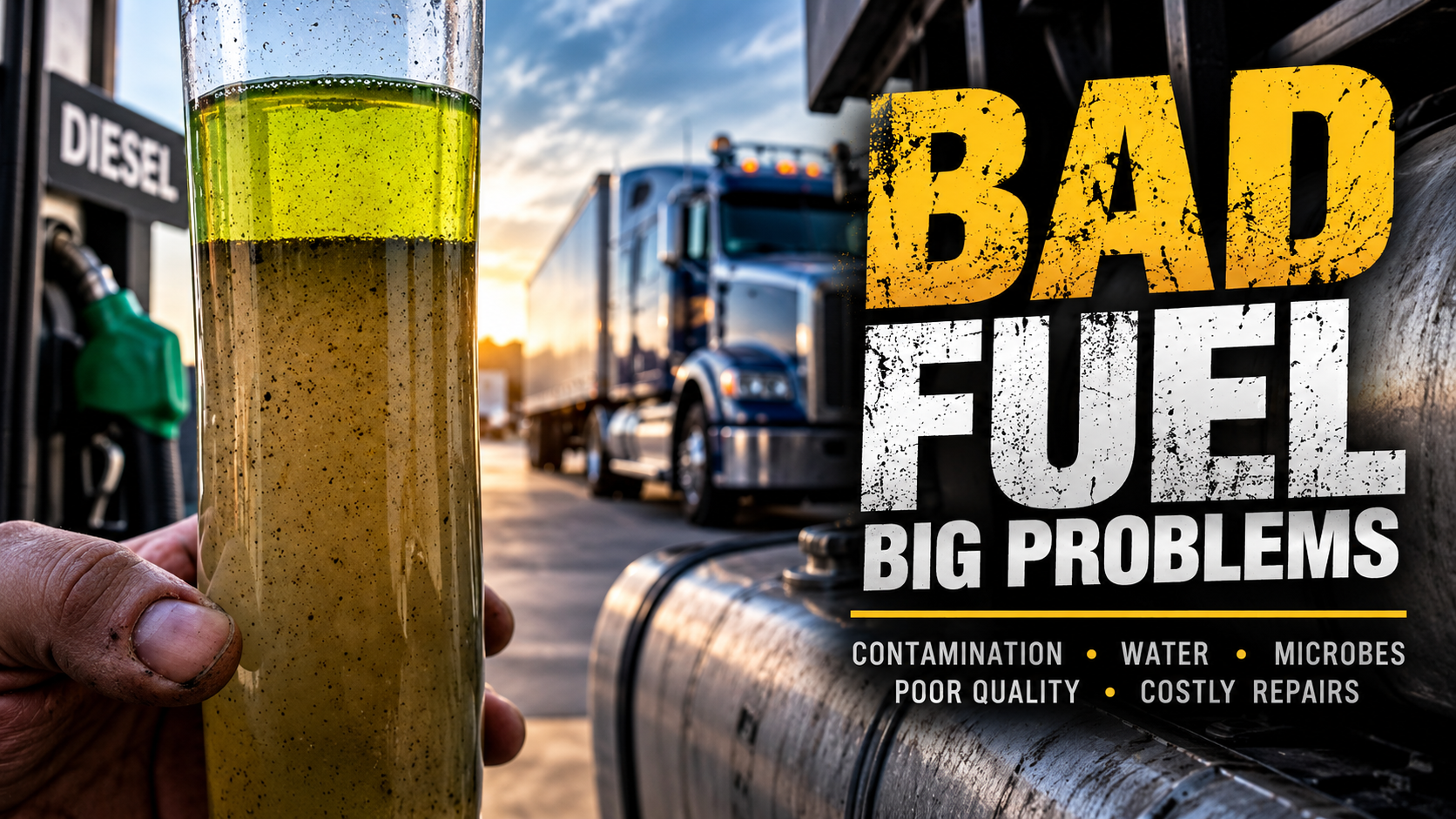
The photo with this piece shows what came out of a fuel filter housing: a water bottle, half water, the rest something that was supposed to be diesel. At $5.60 a gallon, the pressure to buy the cheapest fuel on the exit is real. The engine’s pressure is 30,000 psi, and at that pressure a droplet of water is a cutting tool. Sometimes the lowest price is exactly what you paid for.

Diesel is $5.60 a gallon this week, up $1.87 from a year ago, and every driver and every fleet manager in the country is doing the same math at every exit. Two cents a gallon on 200 gallons is four dollars. Ten cents is twenty. Over a month, over a fleet, it adds up to a number a controller will fight for, and it should.
Not every gallon is the same, and the reason isn’t romance about brand names. It’s chemistry, and it changed under everybody’s feet in 2006.
Modern diesel holds water on purpose. Ultra-low sulfur diesel, mandated at 15 parts per million of sulfur, is cleaner and wetter. The refining that strips the sulfur also strips some of the fuel’s natural stability and lubricity. ULSD holds more dissolved water than the high-sulfur fuel it replaced, and biodiesel, blended into most diesel sold in this country at up to 5 percent without a label on the pump, raises the water affinity further. Lab numbers put ULSD’s water saturation near 50 parts per million at 50 degrees and about 200 at 100 degrees. That means warm fuel carries water it cannot hold once it cools. Every night in a half-empty tank, and every trip from a warm terminal to a cold shoulder, that water drops out of solution and sinks to the bottom, where the pickup is.
Where the cheap fuel comes from. Diesel at the rack is a commodity. What differs is what happens between the rack and your tank: how long it sat, in what, at what temperature, and whether anyone drained the bottom of the storage tank this year. A high-volume truck stop turns its inventory in days. A low-volume station with a low price and a 20-year-old underground tank turns it in weeks, and the bottom of that tank is where water and the microbes that live on the water-fuel interface collect. Those microbes feed preferentially on the biodiesel fraction, leaving acid and sludge behind. A station selling ten cents under market is usually not cheating you. It is usually selling you the bottom of a tank that does not move.
What the engine does with it. A mechanical injection pump from 1995 could drink a little water and keep going. A high-pressure common-rail system cannot. It runs at 30,000 psi and above, with clearances measured in microns, and at that pressure a droplet of water is not a contaminant; it is a projectile that erodes the sealing surfaces of the injector and the pump. The first symptoms are the ones drivers report as “it’s running a little rough”: erratic idle, hesitation under load, unstable rail pressure, a filter that keeps plugging. By the time the check engine light comes on, the injectors are usually already scored.
The bill. A water separator drain and filter change is $100 to $200. One injector is $500 to $1,500. A full set is $3,000 to $8,000. A high-pressure pump is $2,000 to $4,000. A complete fuel system after a bad load of fuel can cost $15,000, plus a week of downtime, plus the load that didn’t deliver. One industry estimate attributed to the Department of Energy puts contaminated fuel injector repairs at about $2 billion a year nationally. Against that, the ten cents a gallon you saved on the exit ramp is a rounding error, and the four dollars a fill you saved buying the cheapest fuel is the most expensive four dollars in the business.
What to do about it, in order.
Drain the water separator on a schedule, not when the light comes on. Every week in humid weather, every fill on a truck that sits.
Keep tanks full when the truck is parked. Air space is where condensation forms.
Buy volume, not price. A pump that sells a lot of diesel sells fresh diesel. If the price is well under the corridor and the lot is empty, that is information.
Cut open a plugged filter before you throw it away. Black sludge or a gel means microbes, and the fix is the fuel source, not another filter. New injectors on a dirty tank fail the same way the old ones did.
Watch rail pressure. On a modern truck, commanded versus actual rail pressure at idle and under load is the earliest honest signal you will get.
If you run a yard tank, test it. Water paste on a stick costs nothing. A microbial test kit costs a few dollars. A batch of bad fuel that goes into twenty trucks on the same morning is the failure mode that ends small fleets.
At $5.60, the temptation is to treat diesel as a price. It is a product, and the cheapest version of it comes with a repair bill attached. The bottle on my bench is what the discount looks like when it finally shows up.
