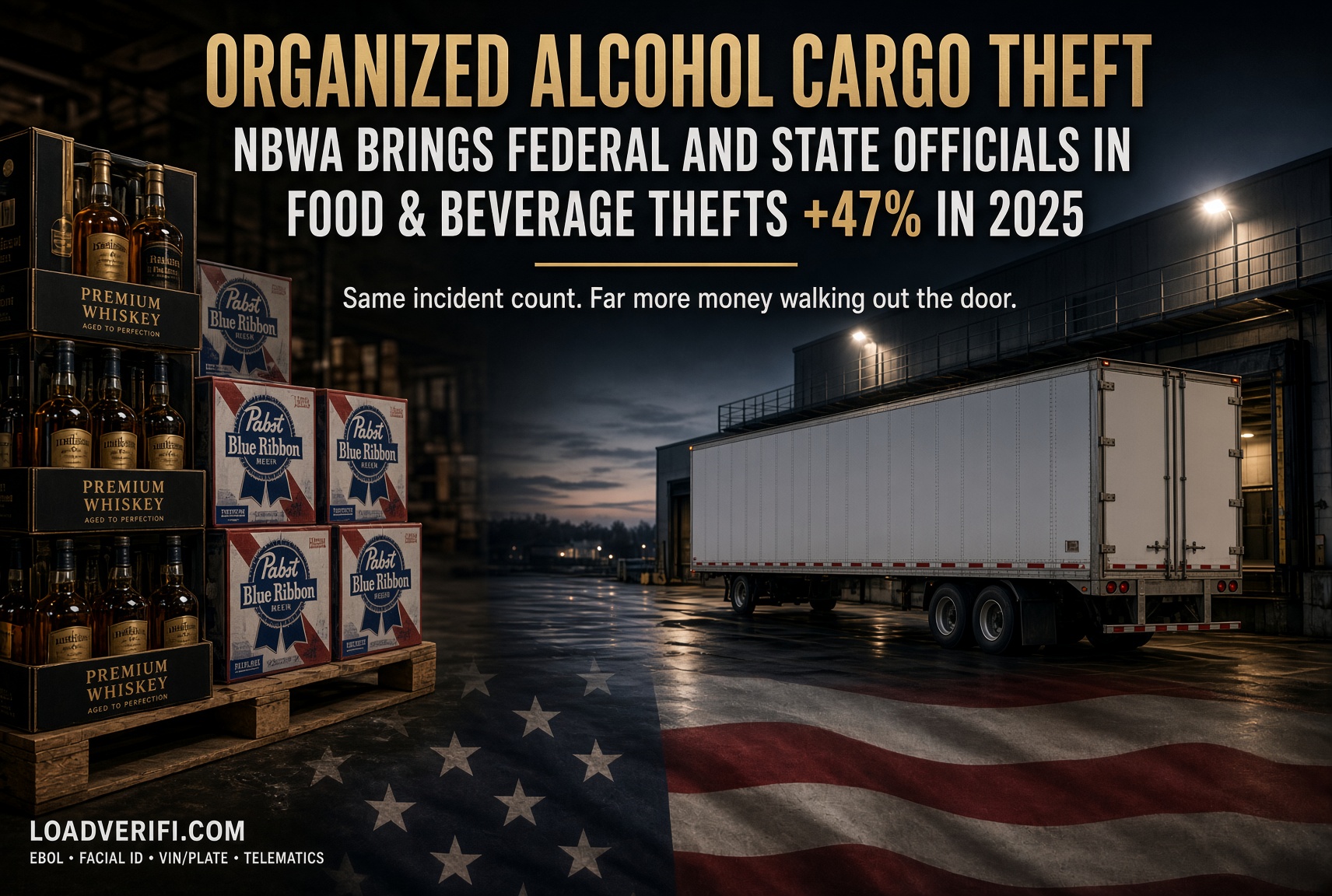
The NBWA convened federal and state leaders this week to confront a surge in organized alcohol cargo theft. The numbers behind the meeting explain why it couldn’t wait.
On September 23, 2026, the National Beer Wholesalers Association joined federal and state officials to examine organized alcohol theft across the American supply chain. The headline on that announcement sounds like a routine industry convening. It isn’t. The groups sitting in that room aren’t responding to a trend. They’re responding to a loss curve that has been running almost vertical for two years, and to a criminal infrastructure that has gotten significantly better at hitting the alcohol distribution channel while the industry was still treating theft as an insurance problem.
One reason I created loadverifi.com in February was that one of our clients is a large liquor manufacturer in Austin, and they had serious theft issues. Other high-value clients had the same issues. Cloned trucks, etc. So we created a system with EBOLs, Facial and ID recognition and matching, VIN and plate cross-checks at pickup, and revalidation at drop-off. We built a universal telematics connection that tracks the driver and carrier end to end, both in the browser on their device and in the telematics systems in the truck. A cryptographic chain secures the load and provides evidence that everything matches and is validated at origin and pickup.
Verisk CargoNet reported in January 2026 that estimated cargo theft losses surged to nearly $725 million in 2025, a 60 percent increase from 2024, with the average value per theft rising to $273,990, up 36 percent from $202,364 the year before. The incident count didn’t move much. CargoNet recorded 3,594 supply chain crime events across the United States and Canada in 2025, essentially unchanged from 3,607 in 2024, but confirmed cargo theft incidents rose sharply, up 18 percent year over year from 2,243 to 2,646. Same number of crimes, far more money walking out the door. That’s what a professional operation looks like when it stops hitting whatever is convenient and starts choosing what to take.
Food and beverage products experienced the largest commodity increase in 2025, with 708 thefts, a 47 percent jump from 2024. Alcohol sits at the center of that category. In Q2 2025 alone, food and beverage saw 180 reported incidents, a 68 percent increase from Q2 2024, and the category accounted for over 20 percent of all cargo thefts, with alcoholic beverages among the primary targets. In Q1 2025, alcoholic beverage theft rose 65 percent year over year. These aren’t isolated events. They’re a pattern, and cargo crime has a name: organized retail crime at freight scale, or, in the industry’s own terms, strategic cargo theft.
Strategic cargo theft is the difference between a driver who walks away with a case and a ring that takes the whole truck, moves it through a parallel distribution network, and has it on a store shelf in another state before the shipper files the police report. The goods are the same. The criminal infrastructure is not. Alcohol is close to ideal for this model. It’s a branded, fungible, high-turnover commodity. A pallet of premium whiskey or a trailer of beer doesn’t require a fence, a chop shop, or a sophisticated buyer. It requires a willing retailer or a bar that doesn’t ask questions, and those aren’t hard to find. The industry term for the downstream market that absorbs stolen beverage product is the gray market, and it functions in plain sight.
Southern California showed exactly how this works in practice. In August 2026, a truck loaded with 40,000 pounds of Pabst Blue Ribbon beer vanished in California, and investigators believed the theft was linked to two other missing truckloads that month as part of an organized cargo theft operation. The stolen load was valued at approximately $70,000. Three trailers in a month, same geography, same commodity class. That’s a network running a route, not three separate opportunistic thefts.
The federal criminal side of this is moving too. Federal prosecutors in New York unsealed an indictment charging eight people in an alleged international cargo theft conspiracy that targeted commercial freight across the United States, with prosecutors alleging the organization stole at least $10 million in cargo between March 2023 and the present. Prosecutors allege members stole a whiskey shipment worth more than $360,000 scheduled to move from Texas to New Jersey. All defendants are presumed innocent unless and until proven guilty. The indictment is an allegation, not a finding. What it does establish is that federal prosecutors now view alcohol as a target commodity worth naming in a conspiracy indictment, not a footnote to electronics or pharmaceutical theft.
The NBWA represents the interests of nearly 5,000 beer distributors throughout the United States, with about 142,000 employees and operations in every state and congressional district. That footprint means that when organized theft hits the alcohol supply chain, it doesn’t hit one company or one corridor. It hits the independent middle tier of the three-tier system, the distributors who physically move product from supplier to retailer, who absorb the uninsured loss, refile the inventory, and rebuild the delivery schedule. Most run fleets of 10 to 50 trucks. They don’t have cargo theft task forces. They have a dispatcher and a phone.
At NBWA’s Legislative Conference in April 2026, members flagged boosting efforts to prevent organized cargo theft as a priority alongside healthcare costs and the CDL workforce. That was the warning shot. The September convening with federal and state officials is the next step, and it reflects how fast the threat has escalated. In April, cargo theft was one item on a list. By September, it’s the subject of a dedicated meeting with law enforcement and regulators in the room.
The geography of the problem matters for anyone running routes in the beverage channel. California, Texas, and New Jersey represented 50 percent of all thefts in one recent quarter. New Jersey surged 119 percent in Q1 2026 compared to Q1 2025, and both California and New Jersey are primary operating environments for organized crime networks, offering dense logistics infrastructure and proximity to major consumer markets, according to Verisk CargoNet’s Q1 2026 analysis. If your routes touch those three states, you’re operating in the country’s most targeted freight corridors for this commodity class.
The most recent full-quarter data adds a complication. Food and beverage theft declined overall in Q2 2026, with alcoholic and non-alcoholic beverages and mixed grocery products collectively falling by 36 events. But severity rose. Estimated losses reached $304.6 million in Q2 2026, more than double the $135.7 million estimated for Q2 2025, as several multimillion-dollar thefts sharply increased financial severity. Fewer incidents, bigger hauls. That’s the signature of a maturing criminal operation, one that’s learned to select loads rather than grab whatever is available. A network that’s getting more selective is not a network that’s retreating. It’s one that’s getting better at its job.
Keith Lewis, vice president of operations for Verisk CargoNet, has described the pattern plainly: “These aren’t opportunistic crimes; they’re calculated operations targeting goods with the highest illicit-market value and easiest resale potential.” Alcohol fits both criteria. It has a known street price, it moves fast, and it doesn’t require any conversion before it can be sold. A stolen electronics shipment needs a buyer who can move hardware. A stolen trailer of spirits needs a liquor store owner who doesn’t ask where the deal came from.
For distributors operating in the affected corridors, the immediate question isn’t what Washington will do about this. That answer will take longer than your next load departing a New Jersey warehouse. The immediate question is what your own exposure looks like: whether your carriers are vetted beyond a certificate of insurance, whether your loads moving through California, Texas, and New Jersey are tracked beyond a driver’s phone call, and whether your insurance coverage reflects the current average theft value of $273,990 per incident, not the number you set five years ago. The NBWA convening federal and state officials is a real signal that the industry’s institutional voice is now treating this as a supply chain security emergency. Your operation doesn’t have to wait for the task force report to act like it is one.
