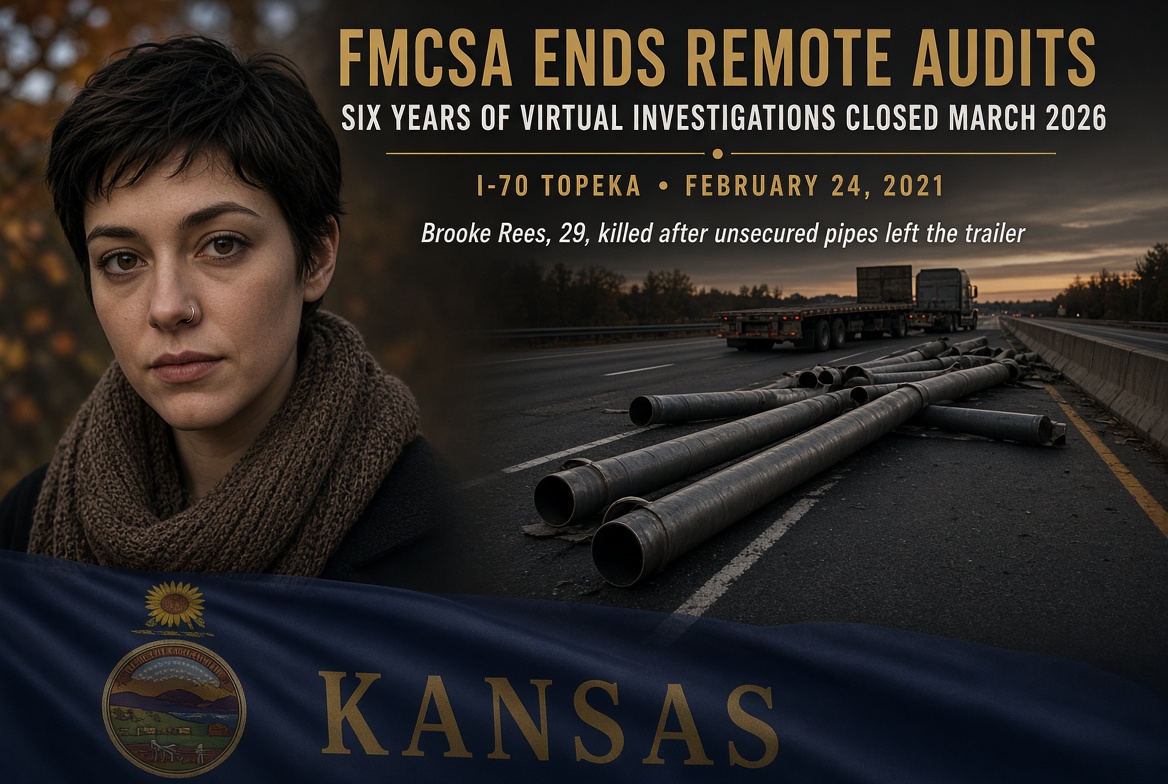
FMCSA spent six years signing off on carriers it had never visited. A March 2026 internal memo, obtained by The Daily Wire, ends that practice. The agency’s own investigators said it was making them less effective. The Topeka crash in 2021 said the same thing in plainer terms.
In February 2021, a truck driver hauling metal pipes made a right-hand turn in Topeka, Kansas. The load slid off the trailer, hit five vehicles and a second truck, and killed one person. The investigation that followed found the driver had an expired medical certificate, no current record of duty status, a missing annual inspection on the truck, and load-securement violations on the cargo that just killed somebody. One month before that crash, FMCSA had investigated the carrier. Investigators reviewed documents remotely and closed the file after a phone call. They never set foot at the business. Under the policy in place at the time, that was a completed investigation.
Philip W. Thomas, deputy associate administrator for safety at FMCSA, put it plainly in an internal memo obtained by The Daily Wire: remote audits “inhibit the ability to fully assess the motor carrier’s compliance and safety measures.” The memo, issued in March 2026, formally ended the virtual-investigation standard in place since 2020 and reinstated what FMCSA called “a meaningful physical presence” at the carrier’s Principal Place of Business, or PPOB in the agency’s shorthand. The direction from Thomas was that “onsite investigations must involve substantive engagement,” not drive-bys, not a stop at the curb to confirm an address exists.
The remote-audit standard didn’t start as a policy choice about enforcement philosophy. It started as a pandemic response. When COVID-19 spread in 2020, FMCSA directed investigators to stop traveling for face-to-face audits and instead have carriers upload documents to a federal portal. That made operational sense in the spring of 2020. The agency never formally rolled it back after the emergency ended. The Biden administration let the virtual standard run through 2021, 2022, 2023, 2024, and into 2025. The Trump administration’s FMCSA killed it in March 2026, according to the Daily Wire report on the Thomas memo.
The numbers show what that six-year stretch looked like in practice. Off-site audits grew by 305 percent between 2018 and 2019, before the pandemic, as FMCSA used the remote format to scale up its reach across a carrier pool of roughly 560,000 regulated entities, according to J.J. Keller & Associates. When COVID arrived in 2020, the pandemic turbo-charged that shift: total investigations dropped from roughly 12,000 in fiscal year 2019 to around 12,000 in fiscal year 2020 as well, but the composition flipped hard toward offsite reviews. By 2022, when a partial return to in-person reviews began, on-site comprehensive investigations had increased 54 percent from 2021 levels, and FMCSA pulled back off-site audits by 31 percent, according to J.J. Keller’s 2022 recap. The agency returned to the building. But the policy didn’t follow the practice. The formal virtual standard stayed on the books until March 2026.
The difference between an offsite and an onsite investigation is not paperwork format. It’s what an investigator can actually find. In an offsite audit, the carrier selects the documents it uploads to the federal portal. The investigator reviews what the carrier decides to send from a regional office, without seeing the yard, the trucks, the maintenance bay, or the people who work there. In an onsite investigation, whether a focused review aimed at a specific safety problem or a comprehensive review of the full operation, the investigator can interview personnel, pull additional records, inspect vehicles sitting in the yard, and follow a thread that wasn’t in the initial document request. That’s the difference Thomas was describing when he wrote that remote audits reduce the “overall effectiveness of the onsite investigation process.” You can’t find the milk crate full of maintenance records from a laptop in a regional office.
The Topeka case makes the mechanism visible. During the remote audit, the carrier told investigators the driver later involved in the fatal crash wasn’t a regular employee; they kept him on the books as an occasional worker. That explanation closed the file. An investigator who had driven to that carrier’s PPOB, walked the yard, and asked the same question in person might have pulled driver qualification files, looked at logbooks, or found the expired medical certificate before the truck moved again. Might have. There’s no certainty in either direction. What’s certain is that the remote audit didn’t find it, and the onsite audit that should have preceded it never happened.
The Thomas memo instructs that when an investigator arrives at a carrier’s location, they’re to conduct what FMCSA calls a “collaborative in-person questioning cycle” with the carrier. The completed investigative report then goes to supervisors and must be “thoroughly reviewed for quality and legal sufficiency” by the division office before the file closes. Remote closure is now permitted only under “extenuating circumstances” involving difficult travel or genuine time constraints, not as standard operating procedure for every compliance review. That language matters. It means the default is the building, the yard, and the person behind the desk. The exception is the screen.
The broader enforcement picture around this memo is worth understanding. FMCSA oversees roughly 560,000 motor carriers. It can’t put an investigator in every yard every year. The offsite audit was built to extend the agency’s reach, and it worked on that metric: offsite volume grew by 18 times from 2017 to 2019, according to J.J. Keller. Volume and effectiveness aren’t the same measurement. An audit that a carrier can game by controlling its document submission is a different instrument than an audit where the investigator decides what to look at. The Federal Motor Carrier Safety Regulations, the FMCSRs, require carriers to maintain specific records, but a remote reviewer can only confirm what lands in the portal. The investigator sitting in the carrier’s conference room can pull the rest of the file. That’s what the Thomas memo is restoring as the standard.
The practical instruction for carriers is simple: if you’ve been operating under the assumption that a federal audit means a document upload and a phone call, that assumption is now wrong. FMCSA investigators are coming to your PPOB. They’ll conduct a questioning cycle with your personnel, review records on-site, and submit a report that must pass legal-sufficiency review before the file closes. If your maintenance records are in a milk crate, if your driver qualification files have gaps, if your drivers of record don’t match the people running your trucks, an in-person investigator will find what a portal submission wouldn’t surface. The window that opened in 2020 closed in March 2026. Plan accordingly.
