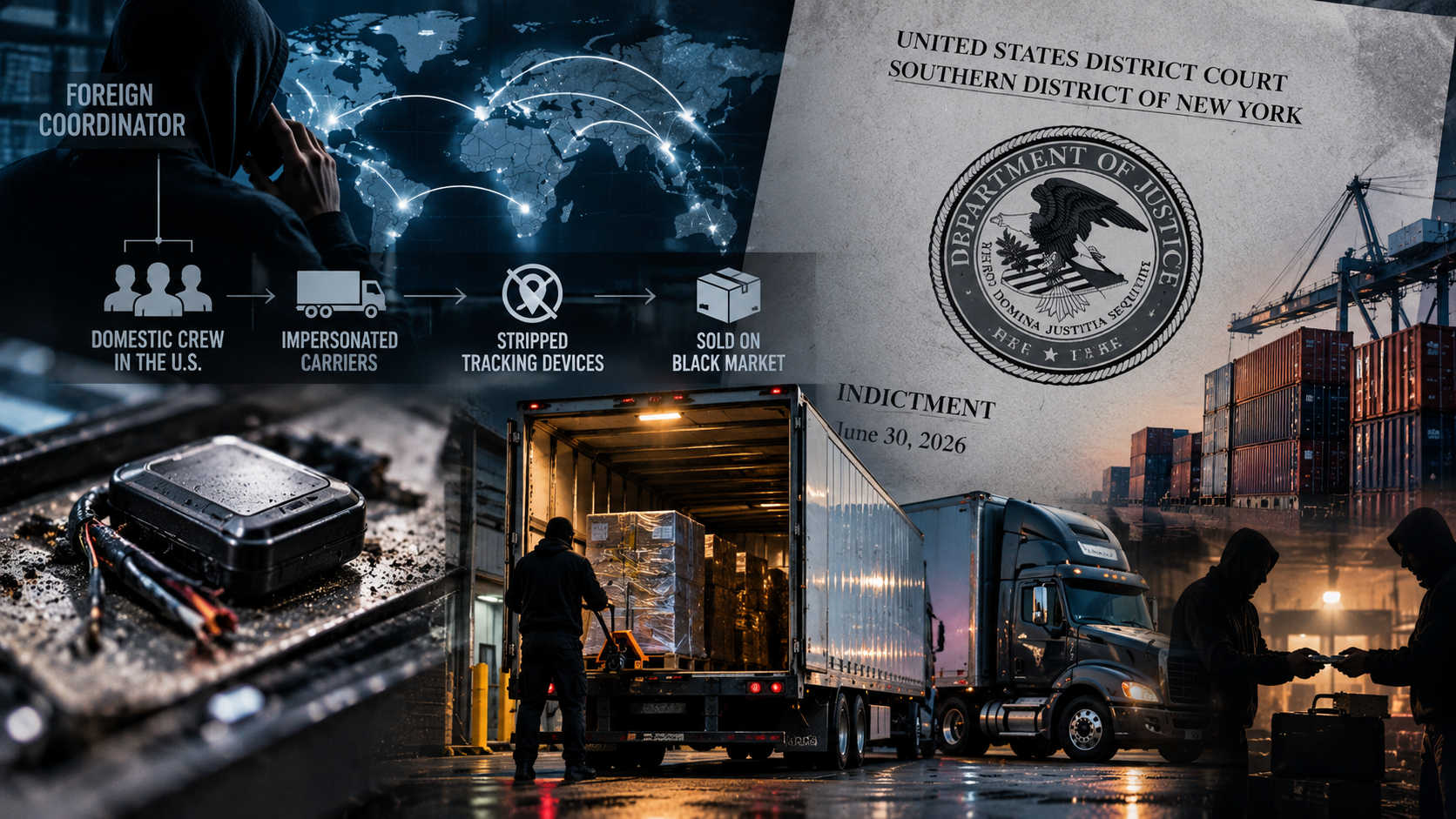
The Southern District of New York’s June 30 indictment against an alleged international cargo theft ring clearly names the mechanism: a foreign coordinator who never touched U.S. soil directing a domestic crew that impersonated carriers, stripped tracking devices, and sold the loads on the black market. That mechanism is not new. The scale and the structure are.
On June 30, 2026, U.S. Attorney Jay Clayton and FBI Assistant Director in Charge James C. Barnacle Jr. announced the unsealing of a federal indictment in the Southern District of New York charging eight defendants with conspiracy to transport and possess stolen property. The alleged scheme ran from March 23, 2023, through the present, prosecutors say, and touched at least $10 million in freight: cryptocurrency mining machines, whiskey, eggs, skincare products, clothing, meat, fish, and electronics. That’s a wide commodity spread for a single conspiracy, and it’s intentional. High-value, fungible, easy to move in secondary markets. The ring didn’t steal one thing. It stole whatever it could turn fast.
Seven of the eight defendants are in custody. Authorities arrested Vagan Gulian, Zhirayr Gumruyan, and Araik Setrakian in California. Vitaly Koshelan was arrested in Florida. Jashanpreet Singh was arrested in Pennsylvania. Authorities arrested Arkadiy Pastin in New York. Sevak Kocharian was already in federal custody on a separate case. The eighth defendant, Edgar Bezhanian, a citizen of Armenia believed to have been living in Eastern Europe during the alleged crimes, remains at large outside the United States, according to prosecutors. He matters most to understanding how this worked.
Bezhanian is described in the indictment as the overseas dispatcher, the person who allegedly told the U.S.-based crew when and where to pick up a load, where to deliver it, and how to change the paperwork to cover the diversion. He reportedly communicated shipping details and altered delivery addresses remotely. That is a two-continent operation running off a single control point, and the control point is somewhere the FBI can’t reach with a warrant. The indictment initially identified him only as “Edgar Lnu,” last name unknown, before his identity was confirmed as Bezhanian. The FBI’s Eurasian Organized Crime Task Force ran the investigation.
The indictment describes what the industry calls fictitious carrier fraud, though the scheme here is more layered than the basic version. In the basic version, a thief registers a shell carrier, picks up a load tendered through a load board or broker, and disappears. Prosecutors allege a more structured scheme: at least one defendant posed as a legitimate shipping carrier or supply chain company to win the freight contract, then other crew members either picked up the shipment or redirected an already moving load by altering delivery addresses and stripping geolocation tracking devices. The stolen goods then moved to a warehouse, where they were unloaded and sold to fences who distributed them through secondary markets. The thieves photographed bills of lading and shared them electronically. They exchanged screenshots of public retail prices for the stolen items to set the black-market rate. That’s not opportunistic theft. That’s logistics.
The indictment details at least five specific thefts. A whiskey shipment valued at more than $360,000, scheduled to move from Texas to New Jersey, was allegedly diverted. Prosecutors allege Kocharian and Setrakian later met in a New Jersey warehouse to discuss selling 8,000 bottles below market, and in Brooklyn to move 200 bottles at a fraction of retail. A skincare and haircare load worth more than $114,000, scheduled to move from Ohio to California in May 2025, was instead redirected to New Jersey and New York warehouses, with Setrakian allegedly coordinating delivery while Koshelan and Pastin transported and unloaded the cargo. The thieves took roughly 23,400 dozen eggs worth $51,000, meant for shipment from Pennsylvania to Utah. A clothing shipment worth $1.2 million, originally bound for Ohio from North Carolina, was diverted. A liqueur load worth $300,000, supposed to go from New Jersey to Virginia, was stolen. Each theft followed roughly the same shape: impersonate or compromise the carrier identity, redirect the load, strip the tracker, move it to a warehouse, sell it below market to someone who then sells it above what they paid but below retail. The fence is the monetization layer. Without the fence, none of it works.
Kocharian faces a second charge beyond the conspiracy count: conspiracy to commit extortion, which carries a maximum of 20 years in federal prison. The conspiracy to transport and possess stolen merchandise charge carries a maximum of five years. All defendants are presumed innocent unless proven guilty beyond a reasonable doubt, and the indictment charges are allegations.
The numbers behind this case don’t live in isolation. Verisk CargoNet’s full-year 2025 analysis, released January 21, 2026, put estimated cargo theft losses across the United States and Canada at nearly $725 million, a 60 percent increase from 2024. The number of incidents barely moved — 3,594 events in 2025 compared to 3,607 in 2024 — but confirmed theft incidents rose 18 percent, from 2,243 to 2,646, and the average value per theft climbed 36 percent to $273,990 from $202,364 the year before. Fewer grabs, more money per grab. That’s the pattern, and the SDNY indictment is a named example of how organized groups are executing it. CargoNet’s Q1 2026 analysis, published April 23, 2026, found that while total events declined 5.3 percent year-over-year, losses held at $131.58 million, and confirmed thefts actually rose by 41 incidents inside that flat total. New Jersey incidents surged 119 percent. The indictment’s repeated references to New Jersey warehouses as a distribution point aren’t incidental to that number.
CargoNet’s 2026 outlook, published with the annual report, named the threat explicitly: theft-by-deception groups are expected to increase their focus on misdirecting shipments tendered to legitimate carriers, sidestepping compliance controls that have traditionally centered on the tendering process itself. The SDNY indictment is that forecast in filed form. The group didn’t just steal loads off the side of the road. Prosecutors allege they got inside the tendering process, changed the paperwork, and walked the load out the front door with a fraudulent bill of lading. That’s the harder problem, and compliance screening at the point of tender doesn’t catch it once the carrier identity has already been compromised or impersonated.
CargoNet also flagged that many complex theft schemes rely on acquiring existing motor carriers with strong load histories, and that increased CDL enforcement may expand the pool of carriers available for sale, potentially giving criminal enterprises new entry points. The alleged scheme here didn’t need to buy a carrier. It allegedly impersonated one. The effect on your vetting is the same: a carrier that looks clean in FMCSA’s system isn’t necessarily the entity that shows up to take your load. The MC number can be real. The company on the other end of the phone can be someone else entirely.
The record in this case does not establish the network’s full scope. Prosecutors said the investigation continues and suggested more participants may be involved, according to reporting on the announcement. It doesn’t establish whether Bezhanian acted alone as the overseas coordinator or whether additional foreign nodes are involved. That question is open, and it matters operationally.
For shippers and brokers tendering freight right now, the directive is straightforward. Verify that the carrier picking up your load is the carrier you contracted with. Confirm dispatch contact information independently, not through the number on the rate confirmation the carrier sends you. Call the carrier’s number directly from FMCSA’s SAFER database. If a driver shows up and the company name on the truck doesn’t match the MC number on your paperwork, stop the load. If someone calls to change a delivery address mid-transit and you didn’t initiate that call, treat it as a diversion attempt until you can confirm otherwise. Geolocation devices on high-value loads aren’t optional anymore, and this indictment shows exactly why: prosecutors allege the crew’s first physical act after diverting a load was stripping the tracker. The tracker is the only record you have of where the load went after it left your dock.
