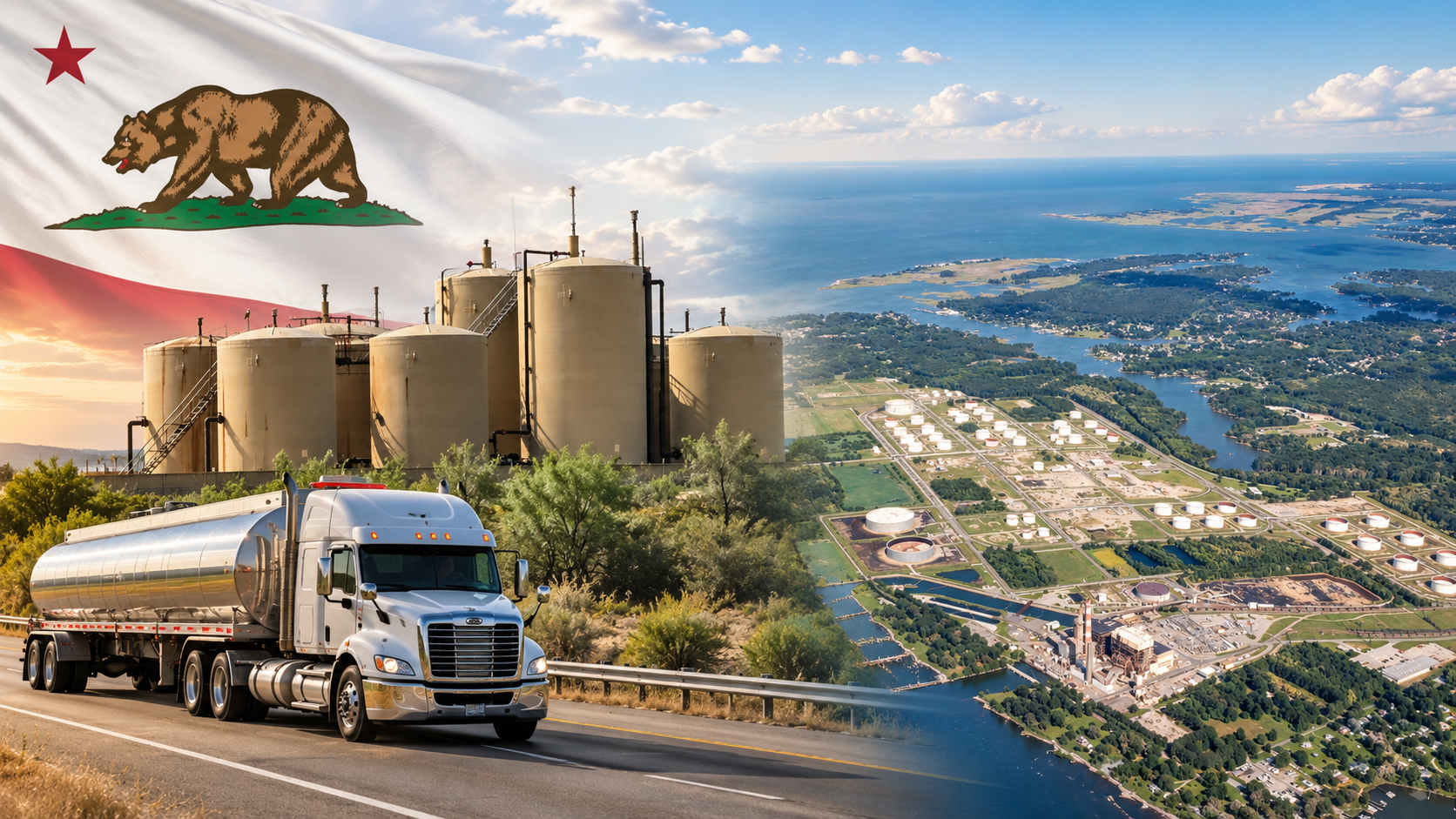
In March I wrote that America’s refining bottleneck was the real vulnerability, not the crude. Six months later the national diesel average is $6.285, California’s is $8.039, and two of the state’s refineries are gone. The question I keep getting from drivers is whether this is being done to them on purpose, ahead of an election. Here’s what the record supports, what it doesn’t, and what would settle it.
The Energy Information Administration put the national on-highway diesel average at $6.285 a gallon for the week of Sept. 14, a record, up $2.546 from a year ago. California’s average was $8.039. Six California stations hit $9.999 the week before, which is not a price ceiling but a digit ceiling, the highest number a three-digit dispenser can display. AAA’s California statewide average hit a record $8.0956 on Sept. 12.
Two things are happening at once, and they’re blaming each other. A war removed barrels from the world’s middle distillate pool. A state took two refineries out of its own supply. The first is why diesel is $6.285 in Ohio. The second is why it’s two dollars higher in Bakersfield.
What I wrote in March, and what held up
My March 9 piece argued that the shortage everyone called a crude problem was a refining problem, and that the United States had spent 30 years building a system with no slack. That call held. EIA’s own chokepoint analysis puts normal flow through the strait at roughly 20 million barrels a day, so that figure described the strait’s entire traffic, not a measured loss.
What California lost
Phillips 66 stopped conventional refining at its 139,000-barrel-a-day Los Angeles complex in the fourth quarter of 2025, an announcement it made in October 2024, two days after Gov. Gavin Newsom signed AB X2-1, which gave the California Energy Commission power to require refiners to hold minimum inventories and backfill supply during maintenance.
Valero notified the CEC on April 16, 2025, that it intended to idle, restructure or cease refining at its 145,000 barrel a day Benicia refinery by the end of April 2026. The company took a $1.1 billion impairment charge on its California assets. It cited operating costs and the regulatory environment, including an $82 million air quality penalty in 2024. California Globe reported the Benicia unit went down Jan. 31, 2026, months ahead of the announced date, and the Senate Environmental Quality Committee’s February briefing confirms the idling and wind-down had already begun.
Together that’s 284,000 barrels a day, roughly 17% of California’s refining capacity, gone in about 14 months. The American Energy Alliance counts eight refineries left in the state as of October 2025, down from more than 40 in 1991. The state consumes around 1.4 million barrels a day and can’t take most out-of-state gasoline because of its unique CARB blend, so the replacement barrel arrives by tanker from Asia or the Gulf, on a 35 to 45 day transit.
EIA said the shortfall would have an outsized effect on the West Coast because the region can’t easily reach other domestic supply.
The question drivers keep asking
Here’s the version I hear at truck stops: they’re doing this on purpose, before an election, the way they’ve done it before.
President Bill Clinton ordered a 30 million barrel release from July to October 2000, weeks before an election, on a heating oil rationale the Energy Department’s own analysis said wouldn’t move heating oil prices much. The Biden administration released 180 million barrels between April and October 2022, finishing with a 15 million barrel announcement three weeks before the midterms, and took reserves to their lowest level since 1984. In March 2026, this administration authorized 172 million barrels in response to the Hormuz closure, oil that takes about 120 days to deliver. As of July 24, the reserve held 308 million barrels, the lowest since 1983. Every one of those decisions had a real supply rationale attached. Each one also landed on a political calendar. Both can be true, and the historical record says they usually are.
On Aug. 10, the President approved a 90-day extension of the Jones Act waiver letting foreign-flagged tankers carry fuel from Gulf Coast ports to California, the thing keeping the state’s pumps and its jet fuel supply moving. Ninety days from Aug. 10 is Nov. 8. The election is Nov. 3. I’m not going to tell you that was the reason for a 90-day term, because 90 days is also the standard term. I am going to tell you that the waiver keeping California supplied expires five days after the polls close, and that somebody should ask, out loud, before the ballots go out, what happens on the sixth day.
If you want to argue that high fuel is being engineered to sway the midterms, you have to answer who benefits. Right now the party in power is bleeding on this issue. Axios reported that Republican incumbents worry about fuel prices in the midterms and that their internal polling shows voters blaming the war. On Sept. 9, at Joint Base Andrews, the president was asked about oil at highs not seen since the early weeks of the war and said, “Right after the election, oil prices are going to be tumbling downward.” GasBuddy’s Patrick De Haan said publicly he sees no guarantee of that. A White House does not engineer a price spike that its own candidates are being buried under two months before an election. The people being held hostage here and the people who’d have to be doing the holding are the same people.
Fuel supply is being managed on a political calendar, in public, by everyone who touches it, and the management is aimed at the news cycle rather than the shortage.
The theater in Sacramento
California is where this gets loud, because the state has the tools and isn’t using them.
After two special sessions, Newsom signed SB X1-2 in 2023 and AB X2-1 in 2024. Between them, the state can require refiners to hold minimum inventories, require resupply planning around maintenance, and cap refiner profit margins through the CEC. The profit cap has never been set. In March, when crude jumped more than $25 a barrel and California pump prices followed, CalMatters reported that those powers were sitting dormant. The oversight division those laws created, the Division of Petroleum Market Oversight, found an unexplained gasoline premium of about 41 cents a gallon between 2015 and 2024, which it valued at roughly $59 billion taken out of California drivers. DPMO opened an investigation into outlier pricing in the Los Angeles and San Bernardino areas on March 19 and subpoenaed the state’s five major refiners. That investigation is open and has proven nothing.
The state has a documented unexplained premium, subpoena power, a statutory profit cap it declined to set, a resupply requirement it can invoke, and the highest prices in the country. Instead, it’s posting about the war. On March 10 the governor wrote that Americans would pay $1.5 billion more at the pump that week because of the war in Iran, which is defensible on the national number and says nothing about why California’s number is two dollars higher than Ohio’s.
The other side runs the same play in reverse. Republican legislators have been citing a USC projection of $8.43 gasoline and calling it Newsom’s crisis, which is fair on the capacity loss and skips the part where a war closed a strait. A Stanford analysis by Neale Mahoney and Ryan Cummings found the Benicia closure’s own effect on pump prices was somewhere between negligible, because California’s marginal barrel is already imported, and 15 cents as a conservative upper bound, conditional on permitting that lets the site convert to an import terminal. Fifteen cents is not $8.43. Both numbers got used as campaign material this year.
The shortage is real, the tankers are real, and the jet fuel inventories that ran to multi-decade lows this summer were real. What’s staged is the argument about it, by people on both ends who each hold levers they’re choosing not to pull because a lower price in October is worth less to them than a villain in November.
What it costs the truck
At $6.285 a gallon and 6 mpg, fuel is $1.05 a mile. The year-over-year increase alone is 42.4 cents a mile, about $42,400 on a truck running 100,000 miles. The American Transportation Research Institute put the industry’s entire average cost of operating a truck in 2025 at $2.336 a mile, with truckload and refrigerated operating margins below 1%. In California, at $8.039, fuel alone is $1.34 a mile.
A contract carrier with a surcharge indexed to the EIA weekly number recovers most of that about a week late. A spot carrier recovers nothing but what the linehaul absorbs. An owner-operator crossing into California is buying the most expensive diesel in the country, filing IFTA on it, paying the federal 24.4 cents a gallon that doesn’t grow when the price does, and running equipment that carries an emissions system the state’s rules helped design and its penalties helped price.
Nothing in the public record establishes that anyone engineered this shortage to move an election. Refining margins blow out in a squeeze because that’s what a squeeze does to margins. Russia’s export ban and the collapse of Persian Gulf product exports would strain any refining system on earth. California’s closures were corporate decisions made by companies that took billion-dollar write-offs to make them, which is an expensive way to run a conspiracy. The Mahoney and Cummings work suggests the closures matter less at the pump than the politics on both sides claim. Every SPR release I listed above, including the ones that landed right before elections, had a genuine supply event behind it.
What would settle it
Whether the Jones Act waiver gets extended again before Nov. 8, and who asks for the extension. Whether any SPR barrels are scheduled to hit the market between now and the election, and when the delivery lands, since the March release took 120 days to deliver. Whether the CEC invokes the resupply and minimum inventory authority it was given in 2024, or leaves it on the shelf through the election. Whether DPMO’s subpoenas to the five refiners produce anything before or after Nov. 3. Whether California refiner margins in the third quarter track the Gulf Coast crack spread or run above it. Whether the price does what the president said it would do right after the election, because that’s now a public, dated, falsifiable prediction, and the EIA publishes the answer every Monday.
My grandfather refined this stuff for a living, at Amoco, BP, Plains and Giant, and he’d have told you a barrel doesn’t know what month it is. The people scheduling the barrels do.
