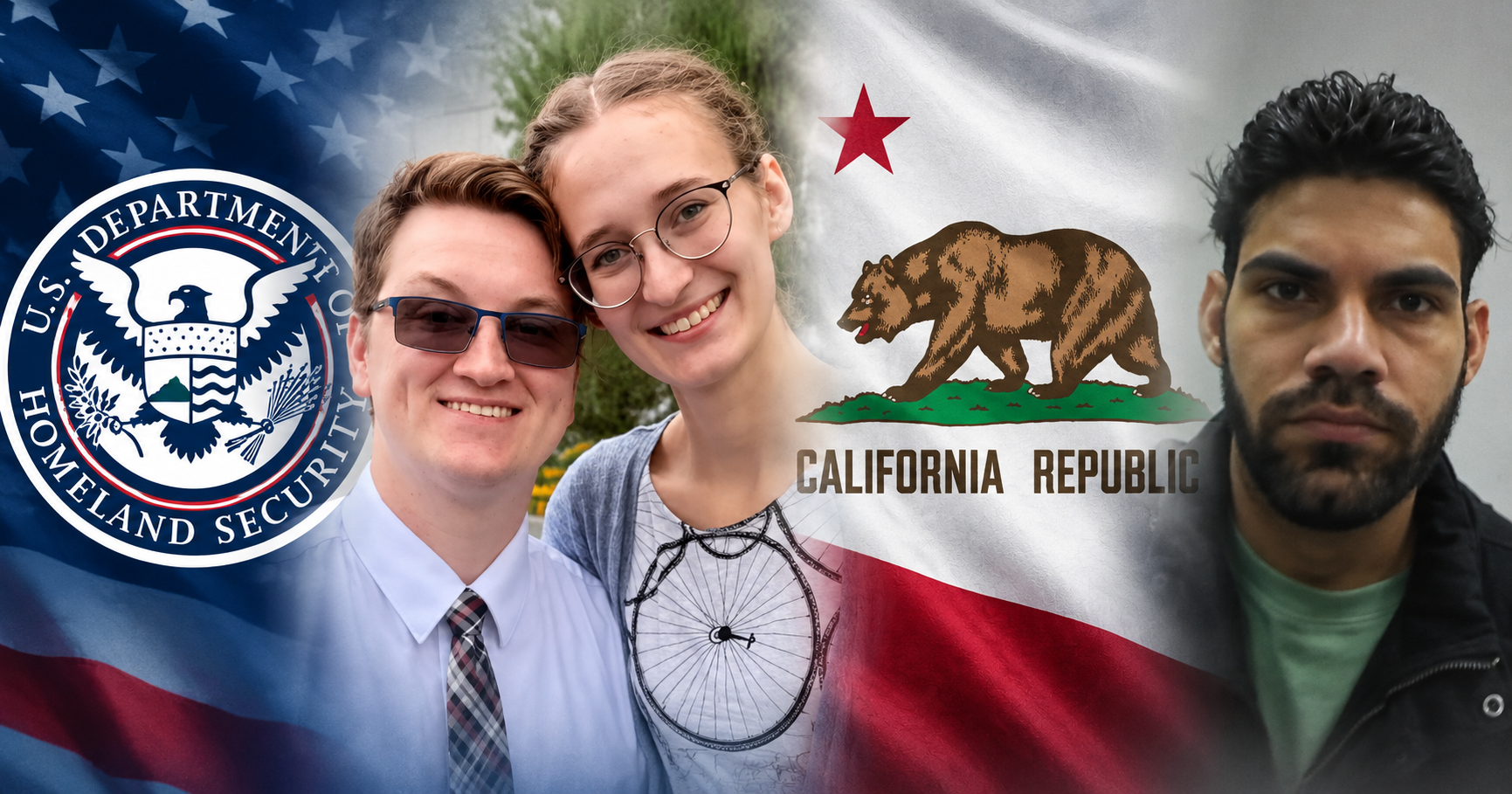
Rajinder Kumar crossed the border illegally in 2022, got a work permit in 2023, and got a California CDL. On November 24, 2025, he jackknifed his semi across U.S. Highway 20 in Deschutes County, Oregon, with no warning equipment out. Billy and Jenny Carter had been married sixteen days.
On November 24, 2025, around 9:30 p.m., a semi-truck jackknifed across both lanes of U.S. Highway 20 near milepost 51 in Deschutes County, Oregon, roughly fifty miles east of Bend. According to Oregon State Police, the driver, 32-year-old Rajinder Kumar of Fresno, California, had left the trailer sitting across the road in the dark with no flares, cones, or warning lights deployed. A Subaru Outback came through at highway speed and hit the trailer. William Micah Carter, 25, and his wife Jennifer Lynn Lower Carter, 24, were killed. Their cat, Bert, died too. They’d been married sixteen days.
That crash is not in dispute. What Kumar was doing behind the wheel of that truck is the question Elizabeth Carter carried to Congress on September 15, 2026, when she testified before the House Judiciary Subcommittee on Immigration Integrity, Security, and Enforcement. She told the committee that Kumar doesn’t speak English. She told them he doesn’t speak Spanish. California administers its CDL knowledge, skills, and road tests in English, according to a letter from the California State Transportation Agency’s general counsel to FMCSA. So the question she was really asking is the one this industry has been sitting on for years: how does a man who can’t read a road sign in either language of the test end up with a commercial driver’s license and an 80,000-pound truck on a two-lane highway at night?
Federal law has required commercial drivers to speak and read English since long before Kumar was born. The rule is 49 CFR 391.11(b)(2). It says a qualified driver must be able to read and speak English sufficiently to converse with the general public, to understand highway traffic signs and signals, to respond to official inquiries, and to make entries on reports and records. That’s not fluency. It’s a functional floor. A driver who can’t meet it isn’t supposed to be in the seat. The requirement has been on the books for decades. What’s changed is whether anyone enforces it.
Enforcement collapsed in 2016, when an FMCSA memo directed law enforcement officers not to place commercial vehicle drivers out of service for language violations. That single memo turned a disqualifying deficiency into a paperwork note. Drivers who couldn’t answer a trooper’s basic questions about their load, their hours, or their route stayed on the road. The rule existed. The consequence didn’t. That gap is what the industry calls an unenforceable standard, and unenforceable standards are not standards at all; they are suggestions with federal letterhead.
The situation started moving in 2025. An April 2025 executive order called for stronger enforcement of the English proficiency requirement. FMCSA released new guidance in May 2025. On June 25, 2025, the Commercial Vehicle Safety Alliance restored noncompliance with 49 CFR 391.11(b)(2) as an out-of-service condition, meaning a trooper who stops a driver who can’t meet the standard can park that truck right there. FMCSA then revised and replaced its enforcement guidance again on April 16, 2026. Congress went further: the Consolidated Appropriations Act of 2026, passed by the House on February 3, 2026, and signed by President Trump, contains a provision requiring FMCSA to update its regulations so that a violation of 391.11(b)(2) expressly triggers an out-of-service order. The codification isn’t final yet; until FMCSA publishes regulatory language and completes rulemaking, the exact text and effective dates remain unsettled — but the direction is clear. The 2016 memo’s damage is being unwound.
None of that happened in time for the night of November 24, 2025.
Federal records document Kumar’s path to that cab. According to the Department of Homeland Security, he entered the United States illegally near Lukeville, Arizona, on November 28, 2022, and was released into the country under the immigration policies then in place. He was granted work authorization in 2023. He then obtained a commercial driver’s license from California, where he was living in Fresno. California’s CDL program for non-domiciled drivers, meaning drivers who aren’t permanent residents, later came under federal scrutiny on a separate track. A federal audit found that roughly 17,000 non-domiciled CDLs had been issued in violation of safety regulations, according to reporting by the International Business Times. FMCSA ordered California to cancel those licenses, and the state completed the revocations in March 2026. Oregon halted its own non-domiciled CDL program the same month. Public records available at this writing haven’t established whether Kumar’s license was among those revoked or a separately issued credential.
Carter told the committee that Kumar was caught the day he crossed at Lukeville and immediately released. He was then, in her words, allowed to stay, allowed to work, and handed a California CDL. Her account of the language issue is the detail that’s drawn the most attention. She told lawmakers that Kumar doesn’t speak English or Spanish, the languages California uses to administer the CDL test. California’s position, stated in its letter to FMCSA, is that it conducts all knowledge, skills, and road tests entirely in English, without translators, and that this satisfies 49 CFR 391.11(b)(2). If that’s accurate, the record still doesn’t explain how Kumar passed the test, or whether the test was administered as California describes.
Oregon State Police arrested Kumar the day after the crash. A five-count indictment filed in Deschutes County charged him with two counts of first-degree manslaughter, a Class A felony, and three counts of recklessly endangering another person. Bail was set at $500,000 after two increases from an original $100,000. ICE lodged a detainer. Oregon is a sanctuary state, and prosecutors acknowledged publicly that coordination with ICE could affect the case. Kumar was released in early April 2026. ICE arrested him on April 22, 2026. As of the most recent public reporting, Kumar is expected to be deported to India rather than tried on the manslaughter charges. The criminal case in Deschutes County has not concluded. Kumar has not been convicted of any offense, and he’s presumed innocent of the charges against him in that proceeding.
Transportation Secretary Sean Duffy responded publicly to Carter’s September 15 testimony, writing that California handed Kumar a commercial driver’s license and a mother paid the ultimate price. That’s a political statement, not a legal finding, and it skips the carrier who hired Kumar, the broker or shipper who tendered the load, and every other link in the chain that put him on Highway 20 that night. Those questions haven’t been asked publicly. A valid CDL alone doesn’t eliminate a carrier’s responsibility to verify that a driver meets all applicable federal qualifications, including the English proficiency requirement under 391.11(b)(2). This piece found no public record establishing whether the carrier that employed Kumar conducted any independent proficiency check.
The broader CDL licensing question isn’t going away. Carter’s testimony put a specific name and a specific road to a policy failure that had been abstract. The FMCSA English proficiency rule is now backed by an out-of-service consequence again, and Congress has directed the agency to codify it permanently. California and the federal government are still disputing whether roadside enforcement is even the state’s obligation. California’s letter to FMCSA argued that there’s no federal requirement to establish English proficiency through roadside inspections, only through the CDL testing process itself. That argument is now on the table at the same moment the family of two people who died on Highway 20 is sitting in a congressional hearing room. Those two facts don’t cancel each other out. They’re the same problem from different ends.
If you hired a driver in the last three years under a California-issued non-domiciled CDL, confirm today whether that license was among the 17,000 FMCSA ordered revoked. Then confirm independently, in a documented interview, that the driver can meet the functional standard in 49 CFR 391.11(b)(2), not just that a CDL was issued, but that your own record shows you verified it. A CDL is a status. What the driver can actually do on a dark two-lane highway is a pattern. The night of November 24, 2025 is what happens when nobody checks the difference.
