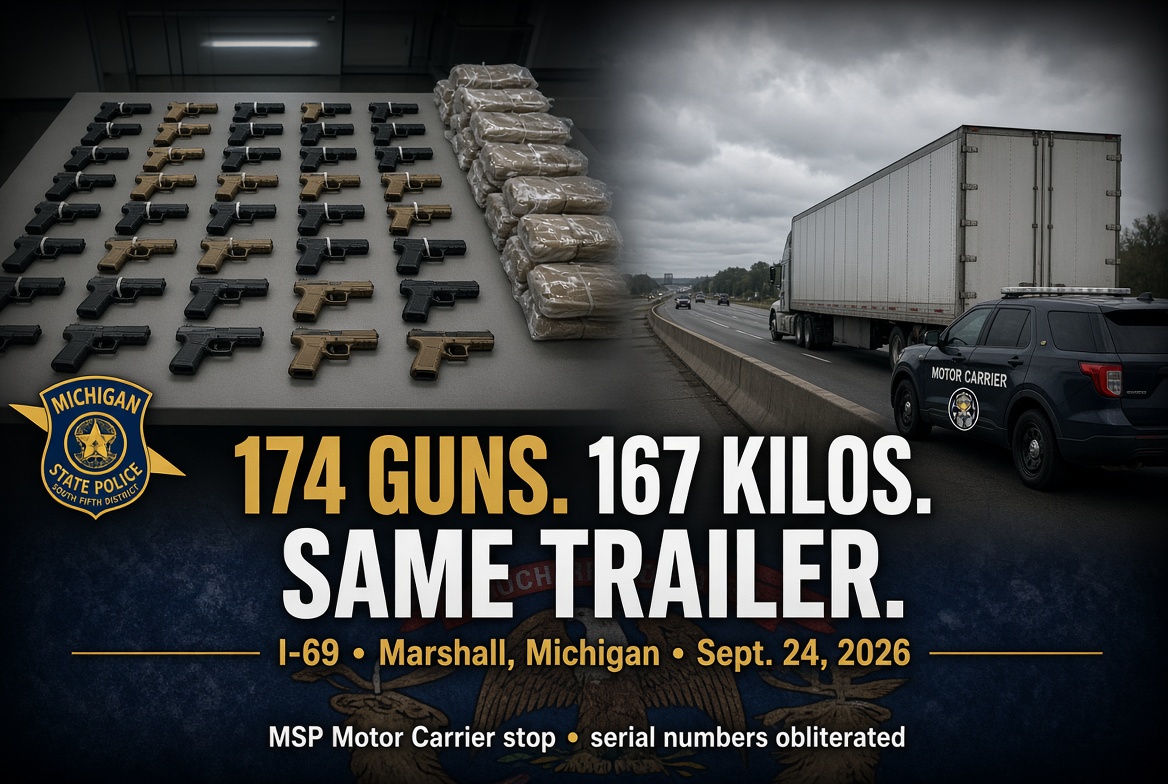
Michigan State Police stopped a commercial truck near Marshall on September 24 and found a weapons cache and a narcotics shipment inside the same trailer. That combination isn’t random. It never is.
Michigan State Police Motor Carrier Officers stopped a semi-truck on Interstate 69 near Marshall, Michigan, on September 24, 2026, around 2 p.m. MSP calls that stop a routine commercial vehicle enforcement action. What they pulled out of the trailer was not routine. According to Michigan State Police, officers seized 174 handguns with obliterated serial numbers and 92 bundles of a substance believed to be heroin, weighing approximately 167 kilograms, or about 368 pounds. The driver, a male, was arrested on drug and weapons-related violations. The investigation is ongoing, according to MSP, which is asking anyone with information about suspected drug activity to contact the agency by email at MSP-ROTECT@michigan.gov or by calling its anonymous tip line at 269-982-8664.
MSP hasn’t released the driver’s name, the carrier, the origin point, or the destination. Investigators haven’t said publicly what triggered the stop beyond it being a commercial vehicle enforcement action. What’s on the record is the cargo, and the cargo tells you a great deal about what kind of shipment this was designed to be. Guns without serial numbers travel with drugs for a reason. They’re not a security detail in the conventional sense. They’re inventory. The firearms and the narcotics are both product, and combining them in one load tells investigators there’s a supply chain behind both, not two separate actors who happened to share a trailer.
The federal statute that governs the firearms piece is 18 U.S.C. § 922(k), which makes it unlawful for any person to knowingly transport, in interstate commerce, any firearm that has had its serial number removed, obliterated, or altered. That’s the paper trail being severed. A serialized firearm can be traced from the manufacturer to the first retail sale to every subsequent transfer through a licensed dealer. Remove the number, and you cut that chain. The gun becomes anonymous. When prosecutors charge under § 922(k) alongside a drug trafficking count, federal sentencing guidelines under U.S.S.G. § 2K2.1 apply a two-level enhancement for obliterated serial numbers, on top of whatever the drug quantity drives the base offense level to. On 167 kilograms of heroin, that base is high. The combined sentencing exposure here, if federal charges follow, is substantial.
MSP Motor Carrier Officers exist precisely because a commercial vehicle is not a passenger car. The cab and sleeper alone offer more concealment space than most storage units. The trailer adds 53 feet of cargo area. Roadside weight and safety inspections give officers a lawful basis to make contact that goes beyond what a traffic stop of a passenger vehicle normally permits. That’s the enforcement architecture Motor Carrier Officers work in, and it’s why the commercial vehicle enforcement lane catches loads that would move invisibly through a standard highway patrol operation.
Marshall sits in Calhoun County, about 36 miles east of Kalamazoo, along I-69. That corridor matters geographically. I-69 connects the Indiana border to the east side of Michigan, running through a stretch of Southwest Michigan that MSP has previously identified as a region where the drug mortality picture is particularly severe. According to MSP statements reported by mlive.com, Southwest Michigan loses more people each year to fatal drug overdoses than to fatal car crashes and homicides combined. A 167-kilogram heroin shipment moving into that corridor isn’t an abstraction. It’s a supply event with a body count attached, if it reaches its destination.
167 kilograms of heroin is not a personal-use quantity. It’s not a mid-level distribution quantity. At street-level pricing, it’s a figure that runs into the millions of dollars, and the 92-bundle packaging suggests the load was already portioned for distribution, not broken down later at a stash house. The fact that 174 handguns traveled in the same vehicle, all with obliterated identifiers, suggests the operation behind this shipment had the scale and infrastructure to move both product lines at once. That’s not two people who made a bad decision. That’s a supply chain.
MSP hasn’t publicly identified the driver, and no prosecutor has announced charges as of the date of this writing. The driver is presumed innocent of any charge not yet proven in court. The record as it stands is an arrest on drug and weapons violations, a seized load, and an ongoing investigation. What the record doesn’t establish yet is the origin of either the firearms or the suspected heroin, the intended delivery point, or who else is involved. Those are the threads MSP and, almost certainly, federal partners are pulling right now.
If you have information about suspected drug activity in the Southwest Michigan corridor, contact MSP at MSP-ROTECT@michigan.gov or call 269-982-8664. If you or someone you know needs information about substance use treatment in Southwest Michigan, Southwest Michigan Behavioral Health can be reached at 800-781-0353.
