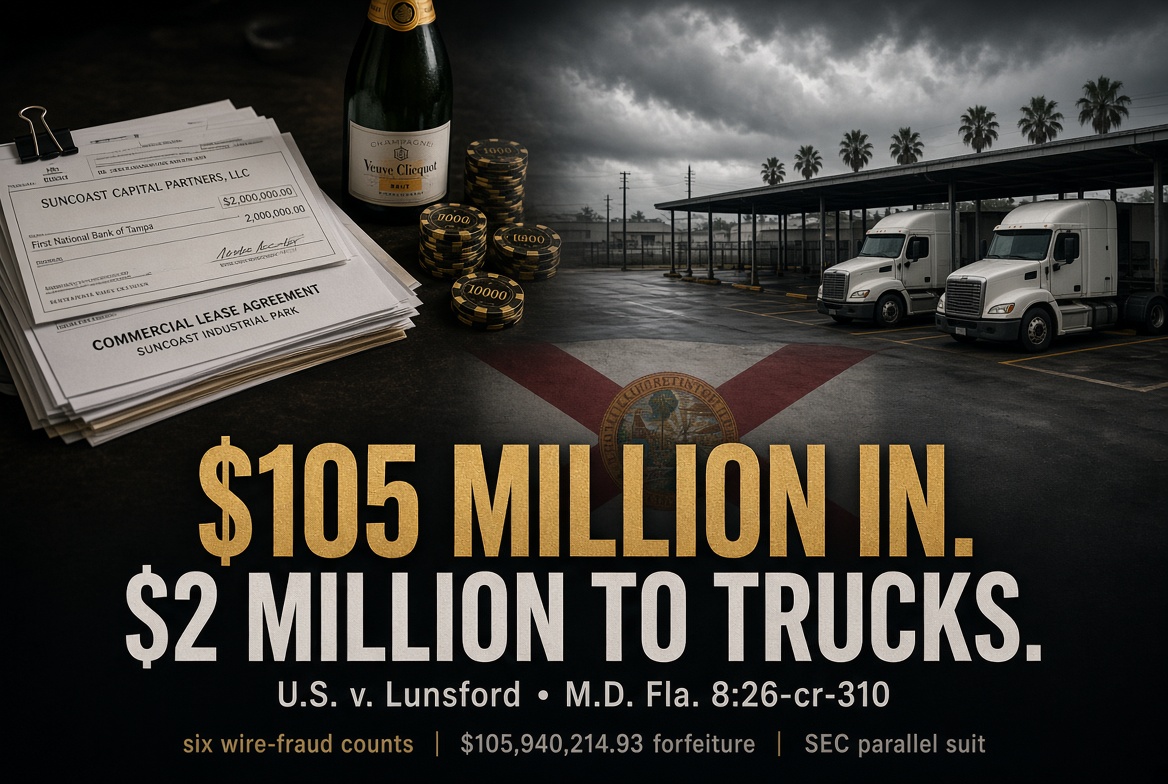
A federal grand jury in Tampa indicted Lunsford on six wire-fraud counts and two money-laundering counts. The DOJ is seeking $105,940,214.93 in forfeiture. The SEC filed a parallel civil action the day before. Almost none of the investor money went to trucks.
On September 25, 2026, a federal grand jury in Tampa returned an indictment against Kristopher Lunsford, 46, of Henderson, Nevada, formerly of Georgia, charging him with six counts of wire fraud and two counts of money laundering, according to the U.S. Attorney’s Office for the Middle District of Florida, Case No. 8:26-cr-310-MSS-CPT. United States Attorney Gregory W. Kehoe made the announcement. That is not the whole picture. The day before the indictment was unsealed, the Securities and Exchange Commission filed its own civil enforcement action, 8:26-cv-02923, in the same courthouse, against Lunsford and his companies AKL Transport LLC and Southern Truck Leasing LLC. The SEC’s complaint puts the total raised at $127 million from approximately 765 investors nationwide. The criminal indictment covers $105 million solicited between December 2023 and May 2025. The gap between those two numbers is one of the threads prosecutors are still pulling.
The pitch was simple enough for almost anyone to follow. You put in $25,000 to $40,000 per truck, according to the indictment, and Lunsford’s operation would handle everything: buying the truck, hiring the driver, securing the insurance, finding the freight. You collected a guaranteed weekly payout of $1,000 to $1,250 and did no work. At $1,250 a week on a $25,000 investment, that’s an annualized return north of 260 percent. A legitimately run trucking company, with real equipment, real drivers, and real freight rates, cannot sustain a return anywhere close to that across a fleet through normal freight cycles. The math was the tell. It was visible before the FBI showed up.
Prosecutors allege the money moved in a pattern that has a name. The industry term is a Ponzi scheme, and the mechanics are straightforward: you pay early investors with money raised from later investors, not profits from actual operations, and the whole structure depends on a continuous flow of new money to stay upright. According to the DOJ’s announcement, Lunsford allegedly used approximately $75 million of new investors’ funds to pay earlier investors and used over $25 million for personal enrichment, including purchases of real estate, sports cars, jewelry, luxury brand items, private charters, and expenditures at resorts, casinos, and nightclubs. The SEC complaint adds granularity: prosecutors allege nearly $10 million in cash withdrawals, approximately $6.2 million for travel, bars, and nightclubs, and at least $1.9 million in casino-related expenses. Of the more than $105 million collected, the DOJ says about $2 million went to actual business-related expenses and operations. That’s $2 million for actual trucks, out of more than $105 million raised. That’s the number that matters.
According to the SEC complaint, Lunsford formed AKL Transport LLC and Southern Truck Leasing LLC in 2023 and was the sole member of each. He ran both from the same address in Dacula, Georgia, which was also his residence, and he was the authorized signatory on each company’s bank accounts. The SEC’s complaint alleges Lunsford and his sales agents told investors the funds would be used to purchase commercial semi-trucks at a discount and operate all aspects of the trucking business, including finding drivers, sourcing cargo loads for transport, and insuring and maintaining the trucks. The SEC filing is case 8:26-cv-02923, filed September 24, 2026, in the U.S. District Court for the Middle District of Florida. Lunsford, AKL Transport, and Southern Truck Leasing consented to proposed judgments in the civil matter without admitting the allegations, according to FreightWaves, and those agreements require court approval before taking effect.
Lunsford is also alleged to have operated through at least two other entities. Fox 13 and Fox 35 reported that he owned and operated AKL and Associates Inc. and Southeast TT in addition to the two companies named in the SEC action. The indictment covers conduct across all of those structures. [ROB: unverified – confirm full list of entity names and their USDOT or state registration numbers; pull from FMCSA and state of Georgia business registry to determine whether any entity held active operating authority and, if so, when it was granted and whether it was ever conditional or revoked]
This is not the first time federal regulators have moved against a trucking passive-income pitch. In August 2024, the FTC and the State of Florida filed suit against RivX and its owner Antonio Rivodo, accusing the company of using deceptive claims of guaranteed income to entice consumers to pay $75,000 or more to buy trucks they often never received, according to the FTC’s press release. That case involved a smaller operation and was a civil enforcement action, not a criminal prosecution. The Lunsford indictment is a criminal matter, with maximum exposure of 20 years per wire fraud count and up to 10 years per money laundering count, per the DOJ announcement. If convicted on all counts, the sentencing exposure is theoretically measured in decades. The DOJ is also pursuing forfeiture of $105,940,214.93, the alleged proceeds of the scheme.
U.S. Attorney Kehoe told reporters that Florida has jurisdiction because victims who reported the alleged scheme are in the Tampa area. Those victims are speaking publicly. WTSP in Tampa quoted two investors, Kellie and Heidi, who said they want to understand how the government will help the people who lost money, not just how it found Lunsford. That is a fair question, and the forfeiture count is designed to answer it, at least partially. Forfeiture orders require the government to trace specific assets back to the scheme before distributing them to victims. How much of the $25 million allegedly spent on real estate, sports cars, and resort stays is still recoverable is a separate proceeding. Assistant U.S. Attorney Ross Roberts is prosecuting the criminal case, with Assistant U.S. Attorney Suzanne Nebesky managing asset forfeiture, according to Tampa Free Press. Investigators arrested Lunsford in Nevada, according to multiple outlets covering the announcement. The FBI’s Tampa Field Office investigated.
The SEC’s civil case is proceeding on a parallel track. SEC Litigation Release No. 26648, dated September 25, 2026, notes that the commission’s Miami Regional Office coordinated with the USAO-MDFL and the FBI’s Tampa Field Office on the investigation. A judge will later determine potential disgorgement, interest, and civil penalties in the civil matter. The criminal case, 8:26-cr-310-MSS-CPT, is before the Middle District of Florida in Tampa at the Sam M. Gibbons United States Courthouse, 801 North Florida Avenue. No trial date is listed in the available public record, and the investigation remains ongoing. U.S. Attorney Kehoe stated publicly that the number of victims and the total amount lost could increase as the investigation continues.
The indictment is an allegation. Kristopher Lunsford is presumed innocent unless and until proven guilty. The record does not establish whether any truck Lunsford’s companies purchased was operated under compliant FMCSA authority, or whether the sales agents alleged to have worked alongside him have been or will be charged separately.
If you believe you invested money with Kristopher Lunsford, the FBI is asking victims to complete a voluntary questionnaire at https://forms.fbi.gov/victims/TruckLeaseFraud/view. Direct questions about the questionnaire to TruckLeaseFraud@fbi.gov. Victim resources and case updates are maintained at http://www.justice.gov/usao-mdfl/kristopher_lunsford. If you received a pitch structured like this one, with a guaranteed weekly payout, a turnkey operator, and no operational documentation you could independently verify, the mechanic is the same whether the name on the door changes or not. Demand VIN lists reconciled to titles, third-party dispatch records, insurance certificates, and audited financials showing payouts came from operating cash, not investor deposits. If those documents don’t exist or can’t be produced, the yield doesn’t justify the risk, and neither does the check.
