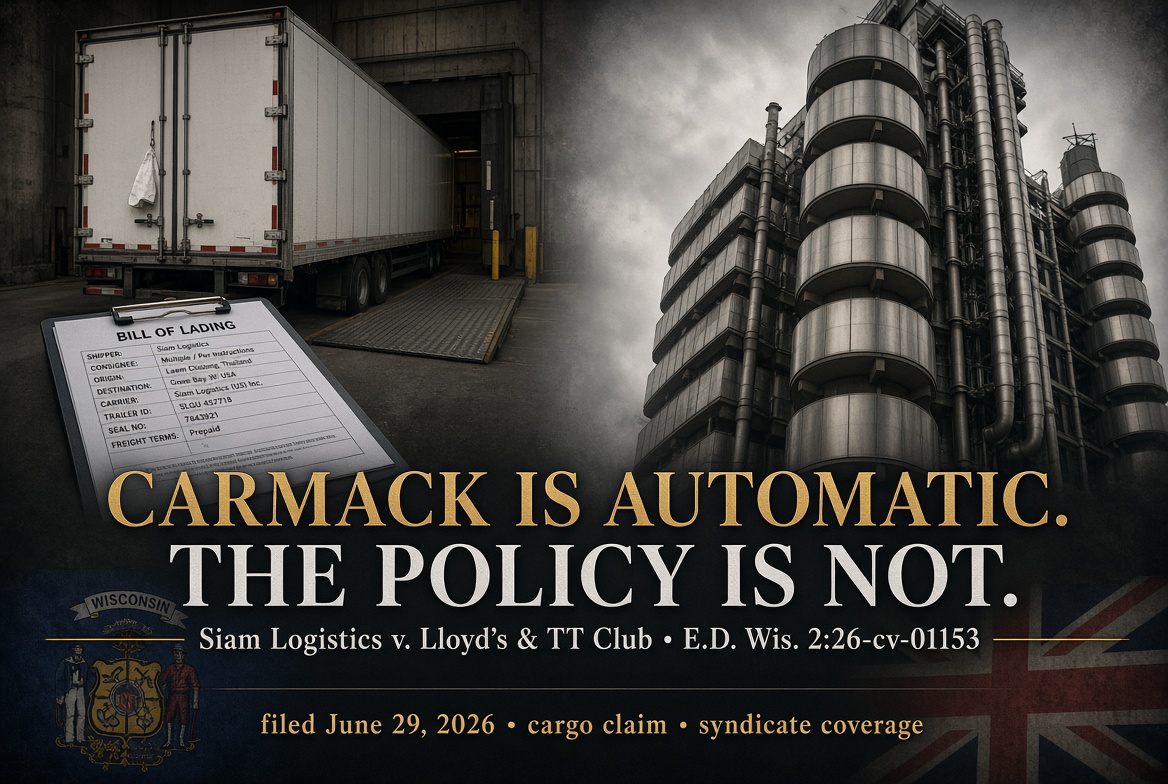
Siam Logistics LLC filed suit against Certain Underwriters at Lloyd’s of London and Through Transport Mutual in the Eastern District of Wisconsin on June 29. The cargo claim underneath it is routine. The insurance architecture above it is not.
Siam Logistics LLC filed a contract dispute against Certain Underwriters at Lloyd’s of London, Trinity Syndicate, and Through Transport Mutual Assurance Association Limited on June 29, 2026, in the United States District Court for the Eastern District of Wisconsin. The case is docket number 2:26-cv-01153, assigned to Judge Nancy Joseph, and is under nature of suit code 110: Insurance, with a cause of action under 28 U.S.C. § 1332 (diversity jurisdiction). That is a carrier suing its cargo insurer in federal court because the parties are from different states, or in this instance, different countries, and the amount in dispute clears the $75,000 threshold. The filing is ordinary in that sense. The defendants are anything but ordinary.
Through Transport Mutual Assurance Association Limited is the entity the industry calls TT Club. It’s a mutual insurer owned by its members that specializes in transport and logistics risk, and it handles roughly 10,000 open claims files at any given time, according to the organization’s own claims management page. Lloyd’s of London isn’t a single insurer. It’s a marketplace where syndicates each agree to cover a percentage of a given policy, which means that when a loss occurs, figuring out which underwriter is on the hook for what share can become a dispute in itself before the underlying cargo claim is ever resolved. The Trinity Syndicate is one of those named underwriting participants here. Siam Logistics apparently had coverage placed through this layered structure, a loss occurred, or a coverage obligation was triggered, and the carrier is now in federal court saying the insurer owes it money it hasn’t paid.
Congress added the Carmack Amendment to the Interstate Commerce Act in 1906 to create a uniform national liability rule for interstate carriers. Under Carmack, codified today at 49 U.S.C. § 14706, a motor carrier is strictly liable for actual damage to cargo it transports, and that liability attaches regardless of cause and without requiring the shipper to prove negligence. The carrier is liable for loss between pickup and delivery unless it can establish one of five recognized common law defenses: an act of God, the public enemy, the shipper’s own act, public authority, or the inherent vice of the commodity itself. Courts have consistently described Carmack as making the carrier something close to, though not quite, an insurer of the cargo in its custody. That near-insurer status is precisely what makes the gap between Carmack liability and actual cargo insurance coverage the most dangerous distance in trucking finance.
A carrier’s Carmack liability is automatic and strict the moment it accepts a load. The cargo policy it buys to fund that liability is a separate contract with its own exclusions, definitions of covered loss, and claims process. Many standard cargo policies exclude losses caused by negligence, leaving the carrier simultaneously on the hook to the shipper under federal law and unprotected by its own policy. Theft involving a fraudulent motor carrier, a double-brokered load picked up by an impersonator, is frequently excluded from standard cargo policies as well. The carrier that discovers this gap after the loss, rather than before, has a business-model problem, not merely an insurance certificate problem, as one industry analysis put it. Siam Logistics is now litigating that discovery in Judge Joseph’s courtroom.
When a broker places a policy through Lloyd’s, several underwriters may each agree to cover a percentage of that policy. That structure spreads the financial risk across the syndicate market, but it also means no single insurer handles the claim. The Trinity Syndicate is named as the Lloyd’s participant here. Through Transport Mutual, TT Club is named separately, which suggests the coverage may have been structured across more than one type of insurer: a mutual on one side and a syndicate subscription on the other. The public docket does not establish whether the dispute is about which party owes the claim, or whether either party owes it at all under the policy’s terms. That question is exactly what 2:26-cv-01153 will answer.
Carriers who read this case as a curiosity about a Milwaukee trucking company and two foreign insurers are reading it wrong. The Carmack exposure every motor carrier carries is not discretionary. It attaches with the bill of lading, and courts have held it preempts state and common-law claims, making it the shipper’s sole recourse for loss or damage in interstate transit. What is discretionary, what the carrier actually controls, is whether its cargo policy is written to fund that liability when the claim arrives. That means the policy language on negligence exclusions, theft exclusions, and the definitions of covered and excluded perils must be read and understood before the load is dispatched, not after a loss triggers a coverage denial. The legal defense, insurance coverage, and settlement leverage depend on the records created by people who believed they were only handling a routine load, as one industry resource noted. Carmack claims are often won or lost at pickup and delivery, months before any lawyer reads the policy.
The practical instruction for any fleet running cargo is this: pull the policy’s exclusion list today and match it against the commodities you actually haul and the loss scenarios your operation actually faces. If the policy excludes negligence-caused loss and your operation moves high-value freight on tight schedules through high-theft corridors, you have a coverage mismatch that a certificate of insurance will not fix. If your highest cargo value per load exceeds the policy limit, you have a structural problem. The question isn’t whether a gap exists in your program. The question is whether you find it before Lloyd’s does.
Siam Logistics LLC v. Certain Underwriters at Lloyd’s of London, Trinity Syndicate, et al., No. 2:26-cv-01153 (E.D. Wis., filed June 29, 2026). The complaint and additional docket filings are available through CourtListener at https://www.courtlistener.com/docket/73549374/ and through PACER. All allegations in this matter are attributed to the pleadings; no court has made findings on the merits. Siam Logistics, Through Transport Mutual Assurance Association Limited, and Certain Underwriters at Lloyd’s of London, Trinity Syndicate, are presumed to have defenses to any claims asserted.
